Momentum: Elastic Collisions Are Two Inelastic Collisions
Yep. I can see my AP Physics C and AP Physics 1 students shaking their heads in disgust at the title. The condescension that I do not know what I am talking about would also be crisp, with that all too familiar sophomore/junior energy- “K, so look, literally inelastic collisions lose energy. So if that happens twice, then
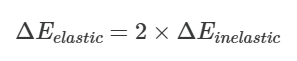
Is that what you are saying? Because that violates the definition of elastic collisions-it does not lose energy. Like, literally!” And you would be right. This is absolutely not true for energy. But the context is the first word of the title- this is about momentum and by going deep into the weeds with that stuff, we’d discover something cool about energy as well!
Collisions: a real example
Let’s start with 1-D collisions for starters. Here’s a video of a baseball bat hitting a baseball. Although momentum isn’t conserved here (because the baseball is pivoted on end), it is a good approximation of what happens with elastic collisions.
In the video above, you’d notice every collision has deformation-it just may not be detectable in real time. When two bodies collide, one transfers some or all of its momentum to the other (and vice versa), such that at one point in time- the bodies are moving together. This is all too familiar- this is similar to the final state of a perfectly inelastic collision (shown below)- but for just an instant of time.
Inelastic collision demo
Elastic collisions: symmetry of forces
Center of mass connection
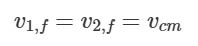
This is even more interesting if we think of the center of mass frame. As the motion of the center of mass is unaffected by the collision (collisions are caused by internal forces only), it must mean that at the point of maximum compression (final state for inelastic collision), the two bodies must be moving with the velocity of the center of mass.
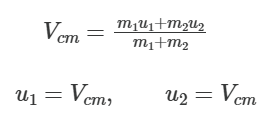
That’s it. For inelastic collisions- that’s the shortcut, find the velocity of the center of mass and that is the final velocity of the objects.
Elastic collisions, center of mass frame
Our final analysis involves elastic collisions and how the center of mass frame analysis could be leveraged to produce a neat little shortcut for these as well. So in the center of mass frame, the velocity of both objects is zero at maximum compression.

The momentum change in the center of mass frame, then is

okay.
Now this change in momentum would be repeated– because as we learned previously, the forces are symmetric in time with respect to an elastic collision. So the same forces would be applied during recoil as with the initial deformation. So,
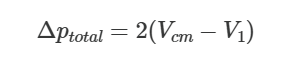
in the center of mass frame. So the final momentum is

in the center of mass frame.
Now, all we need to do to get this to the lab frame is to add the velocity of the center of mass to it. Voila- there you have it! The final form, and it’s deceptively simple:
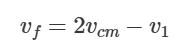
You can use this form without much thought with MCQs, but a word of warning with FRQs: AP graders might not like an equation spawned out of nowhere– you’d have to explain it.
Final Formulae
Inelastic collisions (1D)
Elastic collisions (1D)
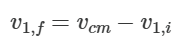
and likewise for the velocity of the second object.
Some honest gotchas
The origin of these formulas is the conservation of linear momentum- plain and simple. So the old ways work, and to be fair, they’re more robust. I will spare you the derivation for 2D or 3D collisions. But there are some gotchas to this technique-it’s not universal.
- It does not really result in clean equations for collisions that are neither elastic nor inelastic- these would require a very clean application of momentum conservation.
- In 2D and higher dimensions the formulas hold only along the line of impact, and only if they are elastic or perfectly inelastic along that direction.