Category: AP

  • Seek2Learn vs Tutor.com for AP Math Tutoring: A Detailed Comparison

    Seek2Learn vs Tutor.com for AP Math Tutoring: A Detailed Comparison

    Seek2Learn vs Tutor.com for AP Math Tutoring

    Seek2Learn and Tutor.com both offer online AP math help, but they are built on opposite ideas. One is designed around quick, on-demand assistance whenever a student is stuck. The other is built around a continuing relationship with a consistent tutor. For AP Calculus, AP Precalculus, or AP Statistics, that difference shapes the whole experience. Here is a detailed, honest comparison to help you decide.

    What AP Math Tutoring Demands

    AP math is college-level and cumulative. AP Calculus and AP Statistics both split their exams evenly between multiple choice and free response, and the free-response section is where many students lose points, because it tests reasoning and clear communication, not just the final answer.

    That means the ideal tutoring setup offers a few specific things:

    • A tutor who knows the specific AP exam, its format, and its scoring.
    • Coaching on free-response technique, built up over time.
    • Continuity, since a full-year course rewards a tutor who tracks progress and adjusts.
    • A plan for the whole arc of preparation, not just isolated problems.

    Keep these in mind, because they are where the two platforms diverge most.

    Tutor.com for AP Math

    Tutor.com, a service of The Princeton Review, is built around on-demand tutoring. A student logs in, connects with an available tutor, and works through a problem, often within minutes, in an online classroom with a shared whiteboard.

    How it works: you subscribe to a monthly plan and use your hours to connect with tutors across many subjects, including AP math. Help is available around the clock.

    Pricing: monthly subscriptions run roughly $40 to $340 depending on hours included, which works out to around $29 to $40 an hour. Unused hours generally expire at the end of the billing cycle, and access is limited to students with a US or Canadian billing address.

    Strengths: the availability is excellent. For a student stuck on a calculus problem late at night, being able to reach a tutor immediately is genuinely useful. The subscription cost is also predictable, and it is backed by a well-known test-prep brand.

    Limitations for AP: the on-demand model means you do not choose or keep the same tutor. Each session may be with someone new who does not know the student’s history, strengths, or the plan so far. For quick homework help that is fine. For structured AP exam preparation, which benefits from a tutor building FRQ skills and a strategy across a whole year, the lack of continuity is a real weakness. Unused hours expiring also pressures you to use time whether you need it that month or not.

    Seek2Learn for AP Math

    Seek2Learn is a global learning platform built around personalized, one-on-one tutoring. Rather than connecting a student to whoever is free, it centers on a consistent tutor who works with the student over time.

    How it works: students get one-on-one sessions, structured courses, and interactive group classes, with smart scheduling and a free demo session to test the fit before committing. The emphasis is on a continuing relationship and a plan built around the student’s goals.

    Strengths for AP: continuity is the main one. A tutor who stays with a student learns how they think, spots the specific gaps costing them points, coaches free-response technique across the year, and adjusts the plan as the exam approaches. That arc is exactly what AP preparation rewards. The global reach also helps students who cannot find an AP specialist locally, and the free demo lets you test fit at no cost.

    Being straight about it: Seek2Learn help evaluate the individual tutor’s specific AP experience before committing. What Seek2Learn offers is a personalized, relationship-based model rather than on-demand volume.

    Side-by-Side Comparison

    Factor Seek2Lrn Tutor.com
    Model Personalized, relationship-based On-demand
    Same Tutor Each Time Yes No
    Availability Scheduled sessions 24/7 on-demand
    FRQ Coaching Over Time Yes, continuous Limited (no continuity)
    Pricing Per session, free demo Subscription, ~$29–40/hr
    Unused Time No expiring hours model Hours typically expire
    Access Global US and Canada billing
    Best For Structured, full-year AP prep Quick homework help anytime

    Which Should You Choose?

    Choose Tutor.com if your student mostly needs quick, on-demand help getting unstuck on specific problems, values round-the-clock access, and does not need a consistent tutor or a long-term plan. Its availability is the strongest reason to pick it.

    Choose Seek2Learn if your student wants a consistent tutor who builds AP skills, especially free-response reasoning, across the whole course, and you value a personalized plan over on-demand volume. The free demo makes it low-risk to try.

    The honest summary: these platforms solve different problems. Tutor.com is a fast answer at midnight. Seek2Learn is a steady climb across a semester with someone who knows the student. For most students preparing seriously for an AP math exam, continuity and FRQ coaching matter more than 24/7 access, which tilts the decision toward a relationship-based model. But if late-night homework rescue is the real need, Tutor.com fits that better. Match the choice to how your student actually studies.

    Related reading: should I take AP Calculus BC,

    and how to prepare for AP Physics C.

    Frequently Asked Questions

    Is Wyzant or Preply better for SAT tutoring?

    For SAT preparation specifically, Wyzant usually has the edge because it carries a much larger pool of experienced SAT specialists. Preply is excellent for languages, but its SAT-focused options are limited.

    How much does SAT tutoring cost on these platforms?

    Both let tutors set their own rates. On Wyzant, most tutors charge between $35 and $65 an hour plus a service fee, with top SAT specialists costing more. Preply rates vary widely, and test prep tends to sit at the higher end of its range.

    Can I try a tutor before paying full price?

    Yes. Wyzant’s Good Fit Guarantee covers your first hour with a new tutor, Preply offers a free replacement or credit if the trial lesson falls short, and Seek2Lrn offers a free demo class before you commit.

    How many sessions do I need to raise my SAT score?**

    It depends on your starting point and target, but many students see meaningful gains over a focused stretch of weekly sessions. A good tutor will set realistic goals after reviewing a recent practice test.

  • Seek2Learn vs Wyzant vs Tutor.com vs Preply: Best AP Math Tutoring Platform (2026)

    Seek2Learn vs Wyzant vs Tutor.com vs Preply: Best AP Math Tutoring Platform (2026)

    Best AP Math Tutoring Platform

    AP Math is not one subject. It covers AP Precalculus, AP Calculus AB and BC, and AP Statistics, and each demands a tutor who knows that specific exam, not just math in general. The stakes are real too, since a strong AP score can earn college credit and save tuition. This comparison breaks down four platforms on what actually matters for AP-level math, so you can match the platform to the student.

    What AP Math Tutoring Actually Requires

    AP courses are college-level, and the exams test more than content. They reward reasoning, specific problem-solving skills, and clear communication, especially on free-response questions that make up half the score on AP Calculus and weigh heavily on AP Statistics.

    So the right platform for AP Math needs:

    • Genuine AP-specific expertise, not just a strong math background. A tutor who has taught the actual exam knows the pacing, the scoring, and where students lose points.
    • Free-response coaching, since FRQ reasoning is half the battle and the hardest part to self-teach.
    • Consistency, because AP courses build across a full year and a tutor who tracks progress beats a rotating cast.
    • The right subject match, since an AP Calculus specialist is not automatically right for AP Statistics.
    • Scheduling and pricing that hold up across months of preparation.

    Wyzant for AP Math Tutoring

    Wyzant is a US tutor marketplace. You browse profiles, read verified reviews, compare rates, and choose your own tutor, keeping that person for the whole course.

    Pricing: tutors set their own rates, commonly $35 to $65 an hour, with sought-after AP specialists charging more, often $80 to $120. Pay-as-you-go, no subscription, first hour protected by the Good Fit Guarantee

    Best for: families who want to handpick a proven AP Calculus or Statistics specialist and pay only for sessions used. Reviews often document real AP score outcomes, which helps you vet.

    Limitation: you do the vetting yourself, and quality varies. Look specifically for tutors who list the exact AP exam, not just calculus or math.

    Tutor.com for AP Math Tutoring

    Tutor.com, a Princeton Review service, is built around on-demand help across many subjects, including AP math.

    Pricing: monthly subscriptions, roughly $40 to $340 depending on hours, around $29 to $40 an hour equivalent. Unused hours usually expire, and access is limited to US and Canadian billing.

    Best for: students who want quick help getting unstuck on a specific problem at any hour, especially near a deadline.

    Limitation: you do not keep the same tutor, so there is no continuity. That is a real drawback for AP prep, which benefits from a tutor who builds a plan across the year and coaches FRQ technique over time. It suits homework rescue more than structured exam preparation.

    Preply for AP Math Tutoring

    Preply is a large global marketplace, strongest in language learning but also carrying academic and AP-level tutors. You browse and pick your own tutor.

    Pricing: tutors set their own rates, which vary widely. Subscription billing based on lessons per week, renewing every four weeks. Paid trial lessons, easy tutor switching.

    Best for: families who want a large international pool and flexible scheduling.

    Limitation: its depth is in languages, so the pool of tutors with genuine AP Calculus or AP Statistics exam experience is thinner and needs careful vetting. An unused balance can be lost on cancellation.

    Seek2Learn for AP Math Tutoring

    Seek2Learn is a global learning platform focused on personalized, one-on-one tutoring, with individual sessions, structured courses, and interactive group classes, plus smart scheduling and a free demo session.

    The model centers on a consistent tutor relationship, which suits AP Math, where a full year of cumulative material and FRQ skill-building rewards continuity. Its global reach also helps families who cannot find an AP specialist locally.

    As with any platform, evaluate the individual tutor’s specific AP exam experience before committing. What it offers is continuity and personal attention with a free-to-try model.

    Best for: families who want a consistent tutor and a personalized AP plan rather than a marketplace search or on-demand help.

    Side-by-Side Comparison

    Factor Seek2Lrn Wyzant Tutor.com Preply
    Model Personalized platform Marketplace On-demand Marketplace
    Same Tutor Each Time Yes Yes No Yes
    AP-Specific Depth Depends on tutor Strong, yet by exam Broad, general Thinner (language-first)
    FRQ Coaching Over Time Yes, relationship-based Yes, if tutor fits Weak (no continuity) Depends on tutor
    Pricing Per session, free demo ~$35–120/hr Subscription, ~$29–40/hr Subscription, varies
    Scheduling Flexible, scheduled Flexible, scheduled 24/7 on-demand Flexible, scheduled
    Best Use Ongoing AP prep Pick your own specialist Quick homework help Wide pool, some languages

    The table compares platforms, but the individual tutor’s AP experience matters just as much as any feature. Always confirm the tutor has taught the specific exam your student is taking.

    Which Should You Choose?

    For structured, full-year AP preparation, continuity wins. A platform where you keep the same tutor, Seek2Learn, Wyzant, or Preply, beats on-demand help, because AP success comes from steady FRQ practice and a plan that adjusts over time.

    For quick homework help at any hour, Tutor.com’s on-demand model works, if you accept the lack of continuity.

    For handpicking a proven AP specialist, Wyzant’s reviewed marketplace gives you the most to vet, just filter for the exact AP exam.

    For a personalized AP plan without the vetting legwork, Seek2Learn’s matched, free-to-try model is worth trying.

    There is no single best AP Math tutoring platform for everyone. The one constant: confirm the tutor has real experience with your student’s specific AP exam, start with a free trial or demo where offered, and judge the tutor as much as the platform.

    Related reading: Seek2Learn vs Tutor.com for AP Physics, should I take AP Calculus BC, and daily habits for AP Calculus success.

  • When to Start Preparing for AP Exams: A Month-by-Month Study Plan

    When to Start Preparing for AP Exams: A Month-by-Month Study Plan

    When Should You Start Preparing for AP Exams?

    The most common question students ask about AP exams is also the one they usually answer wrong. When should I start studying? Most students start too late, cramming in April for exams that test a full year of college-level material. It rarely goes well.

    Here is the better way to think about it. AP exams reward steady preparation spread across the year, not a heroic final push. The good news is that starting early does not mean studying hard for months on end. It means light, consistent habits during the year and a focused ramp-up near the exam. Here is a month-by-month plan that keeps AP exam preparation manageable and effective.

    The Short Answer

    For most students, real exam-focused review should begin about two to three months before the May exams, so around February or March. But that only works if you have been keeping up with the course all year. The biggest mistake is treating the whole year as class and then trying to convert to exam prep overnight in spring.

    Think of it in two modes. During the year, your job is to learn the material well as you go. In late winter, you shift into exam mode. The students who struggle are the ones who never learned it well the first time and try to relearn a year of content in a few weeks.

    Fall: Build the Foundation (September to November)

    Your main job in the fall is simple: learn each unit well as your class covers it. Do not fall behind, because AP courses build on themselves and early gaps compound.

    This is not exam-cram season, and you should not treat it that way. The light habit that pays off now is keeping an error notebook from day one. Every time you miss something on a test or problem set, write down why. You are quietly building a map of your weak spots that will be gold when exam season arrives.

    If a concept genuinely does not click, deal with it now while there is time, not in April when it is buried under everything else.

    Seek2Lrn Tip

    The single highest-value fall habit is not letting a confusing topic slide. A gap in October is a small problem. The same gap in April, sitting under six months of material built on top of it, is a big one. Address confusion when it is small.

    Winter: Start Light Review (December to January)

    As you hit the halfway point, begin light review of earlier units alongside your current coursework. You are not in full exam mode yet, but you want to keep old material from fading.

    A good winter habit is revisiting one earlier unit a week while you keep up with class. This is also the ideal time to take stock. Look back at your error notebook and identify the units that gave you the most trouble. Those become your priorities when serious prep begins.

    If you are considering outside help for a tough subject, winter is a smart time to start, well before the spring rush when tutors get booked and your own schedule tightens.

    Early Spring: Shift Into Exam Mode (February to March)

    This is when real AP exam preparation begins for most students. Now you actively study for the test, not just the class.

    Start taking practice questions by topic, focusing on your weak areas first. Learn the specific format of each of your AP exams, since they differ by subject in how multiple choice and free response are weighted and timed. Begin working free-response questions, because they are usually about half your score and the best test of real understanding.

    Build a realistic weekly routine now. A few focused sessions a week, each targeting a specific weakness or question type, beat occasional long cram sessions. Consistency is still the theme.

    Seek2Lrn Tip

    Spread your exams out in your planning. If you have four AP exams in one week in May, you cannot prepare for all four the week before. Map backward from each exam date now, in early spring, so the heaviest subjects get the earliest start. A calendar beats panic every time.

    Mid-Spring: Full Practice and Timed Work (April)

    April is for putting it all together under real conditions. Take full-length practice tests, timed, for your major subjects. This builds the stamina and pacing that short drills cannot.

    Review every practice test carefully. The score matters less than understanding why you missed what you missed. Keep working FRQs against official scoring guidelines so you know what earns points. Return to your weakest topics one more time, using official practice materials, which reflect the real exam most accurately.

    What you should not do in April is try to learn entire units from scratch. If you kept up during the year, this month is about sharpening, not first-time learning. That is exactly why starting early matters so much.

    The Final Weeks: Sharpen and Rest (Early May)

    In the last week or two before each exam, ease off rather than pile on. Do light review of your notes and error notebook, not heavy new studying. Make sure you know the logistics: your test date, what to bring, and how any digital testing apps work.

    Sleep matters more than one more late-night session. A rested brain recalls and reasons better than an exhausted one that crammed until 2 a.m. Trust the work you have already done.

    What If You Are Starting Late?

    If it is already spring and you have not kept up, do not panic, but be strategic. Take a practice test to find your weakest areas, prioritize the highest-value topics rather than trying to cover everything, and do a timed practice test each week. You may not have time to master it all, so aim for the biggest score gains. And consider getting help to move faster, since a tutor can target exactly what is costing you points when time is short.

    The Real Takeaway

    The best AP preparation is not a frantic spring sprint. It is learning the material well during the year, reviewing lightly through winter, shifting into exam mode a couple of months out, and sharpening with full practice in April. Start the light habits early, and the heavy lifting never has to happen.

    If you want structure or help with a difficult subject, starting with a tutor in winter rather than spring gives you room to actually improve before the exams. Seek2Lrn is one option for that kind of ongoing, personalized support. However you prepare, the principle holds: consistent effort over the year beats any last-minute cram, and it is far less stressful too.

    Related reading: why most students fail AP exams, can you self-study AP Chemistry, and how to study for AP Physics.

  • Can You Self-Study AP Chemistry? What Students Should Know Before Starting

    Can You Self-Study AP Chemistry? What Students Should Know Before Starting

    Can You Self-Study AP Chemistry?

    Maybe your school does not offer AP Chemistry. Maybe it conflicts with another class you need. Or maybe you just want the challenge and the college credit. Whatever the reason, you are wondering if you can teach yourself AP Chemistry and walk into the May exam ready.

    The honest answer is yes, it is possible, but it is one of the harder AP courses to self-study, and going in with clear eyes matters. Some students pull it off and score a 5. Others underestimate it and stall out by winter. The difference is rarely raw talent. It is preparation, honesty about your own foundation, and a realistic plan. Here is what to weigh before you commit.

    Be Honest About What You Are Taking On

    AP Chemistry is a college-level, first-year chemistry course. The framework spans nine units and emphasizes six science practices, including building models, analyzing data, running mathematical routines, and constructing arguments from evidence.

    That last part is what makes self-study tricky. AP Chemistry is not a memorization course, and without a teacher it is not easy. The exam tests whether you can reason through unfamiliar situations, interpret data, and explain your thinking in writing. You can memorize every reaction and still lose points if you cannot justify why something happens. Teaching yourself that kind of reasoning, without a teacher to correct you, is the real challenge.

    What the Exam Looks Like

    Know your target before you start. The AP Chemistry exam is a hybrid digital test. You answer the multiple-choice questions and view the free-response questions in the Bluebook app, and you handwrite your free-response answers in a paper booklet.

    The format is 60 multiple-choice questions and 7 free-response questions, split evenly at 50% each. A calculator and the equation sheet are allowed on the free-response section. Here is a detail many self-studiers miss until too late: calculators are not allowed on the multiple-choice section. You do that stoichiometry and those pH estimates by reasoning and mental math. If you practice only with a calculator in hand, you will be unprepared for how the MCQ section actually works.

    Who Can Realistically Self-Study It?

    Be honest with yourself here, because it saves a lot of pain later.

    You are a good candidate if you have a solid foundation in algebra, since much of AP Chem is quantitative, and ideally some prior exposure to basic chemistry. Strong self-discipline is non-negotiable, because nobody is assigning you homework or checking your progress. And you need to be comfortable seeking out help when you get stuck, whether from online communities, resources, or a tutor, because you will get stuck.

    You should think twice if your math foundation is shaky, if you have never taken any chemistry before, or if you know you struggle to stay consistent without external structure. None of these means you cannot do it, but they mean self-study alone may not be the smartest path. A hybrid approach, mostly self-study with some outside help, might serve you better.

    Seek2Lrn Tip

    Before committing to full self-study, work through one unit on your own as a test run, then check your answers against official practice questions. If you can learn a unit and score reasonably on real AP-style questions without help, that is strong evidence you can handle the rest. If you cannot, you have learned something important before it cost you a whole year.

    A Realistic Self-Study Plan

    If you decide to go for it, structure is everything, because you have none imposed on you.

    Start early and map the units. Spread the nine units across your available months with a clear schedule. Do not leave the hard units (equilibrium, thermodynamics, and electrochemistry) for the end. Chief Reader reports consistently flag these as the units where students lose the most points.

    Learn actively, not passively. Reading the textbook is not studying. Work problems, then check them. The struggle of solving is where the learning happens, not the reading.

    Practice free response from early on. FRQs are half your score and the hardest part to self-teach. Work official past questions against the scoring guidelines so you learn what actually earns points. Practice writing your reasoning clearly, not just getting the number.

    Do the no-calculator practice. Train your mental math and estimation for the multiple-choice section specifically. Do not let a calculator become a crutch.

    Review your mistakes. Keep an error notebook. For every miss, write down why. After a few weeks, your personal pattern appears, and it is usually a short, fixable list.

    Free and Reliable Resources

    You do not have to do this blind. Khan Academy offers a full, free, structured AP Chemistry curriculum. The College Board’s official AP Chemistry materials, including past free-response questions and scoring guidelines, show you exactly what the exam expects. PhET offers free interactive simulations for concepts that are hard to picture. Start with official and official-partner materials before anything else.

    When to Bring in Some Help

    Self-study does not have to be all or nothing. The most common failure point is hitting a concept you cannot crack alone, spending hours stuck, and losing momentum. That is the moment a little outside help pays off.

    You do not necessarily need a tutor for the whole course. Even occasional sessions to unstick a hard unit, get feedback on your FRQ writing, or check that your reasoning is sound can keep a self-study plan on track. Think of it as targeted support rather than a full program.

    Seek2Lrn Tip

    If you self-study, get someone to review your free-response answers periodically, even just occasionally. FRQ reasoning is the single hardest thing to judge on your own, because you cannot always see where your own explanation falls short. An outside read catches gaps that will otherwise cost you points on exam day.

    So, Should You Self-Study AP Chemistry?

    You can, and students do it successfully every year. It works best if you have a solid math foundation, real self-discipline, and the honesty to get help when you need it. It is a poor fit if your fundamentals are shaky or you rely on external structure to stay on track.

    If you fall somewhere in between, consider a middle path: self-study most of it, and use a tutor for the concepts and FRQ feedback that are hardest to manage alone. Seek2Lrn is one option for that kind of flexible, targeted support, connecting you with tutors when you need an expert eye rather than a full course. Whatever you choose, start early, learn actively, and be honest with yourself about how it is going. That honesty is what separates the students who succeed from the ones who stall.

    Related reading: how to choose the right AP Chemistry tutor and why most students fail AP exams.

  • How to Study for AP Physics: A Study Plan That Actually Works

    How to Study for AP Physics: A Study Plan That Actually Works

    How to Study for AP Physics

    Most students who struggle in AP Physics are not struggling because the topics are impossible. They struggle because they study physics like it is a memorization subject, and it is not. You can memorize every equation on the sheet and still freeze on a problem that asks you to think. Physics rewards reasoning and practice, and the students who score well have usually built the right habits, not just logged the most hours.

    This plan works across the AP Physics courses, whether you are taking the algebra-based Physics 1 or the calculus-based Physics C. The core approach is the same. The math level differs, but the way you should study does not.

    AP Physics Study Tips

    A quick orientation, because the AP Physics courses changed recently.

    AP Physics 1 is algebra-based and now covers eight units, including fluids, which moved over from Physics 2. The current exam has 40 multiple-choice questions in 80 minutes and 4 free-response questions in 100 minutes, each section worth half, with a calculator and equation sheet allowed on both.

    AP Physics C is calculus-based and comes as two separate courses and exams: Mechanics, and Electricity and Magnetism. Each has 40 multiple-choice questions and 4 free-response questions, again split evenly, with a calculator and equation sheet allowed throughout.

    Either way, free response is half your score, and both exams provide an equation sheet. That last fact should reshape how you study, which brings us to the first habit.

    Habit 1: Understand Concepts Before Formulas

    Since the equation sheet is provided, memorizing formulas is not the goal. Knowing when and why to use them is. This is the single biggest mindset shift for physics.

    Most students grab a formula and hunt for numbers to plug in. Flip that. Understand what is physically happening first, and the right equation becomes obvious. Before you write anything, ask yourself what is going on in the problem. What is moving, what forces act, what is conserved? Once you can describe the situation in words, the math follows.

    Seek2Lrn Tip

    Practice explaining a problem out loud before solving it. If you can say what is physically happening in a sentence or two, you understand it well enough to choose the right approach. If you cannot, no formula will save you, and you have found exactly what to review.

    Habit 2: Solve More Than You Read

    Physics is not a reading subject. You can watch someone solve a problem perfectly and still be lost on a blank one, because watching is not the same as doing.

    Build your study time around active problem solving. A good daily session is short: review one concept, solve a few problems, then spend real time analyzing what went wrong. The number of problems matters far less than the quality of your review. Five problems you fully understand beat twenty you rush through.

    Aim for consistency over marathons. Thirty to forty-five focused minutes most days does more than one long weekend cram, because physics skills fade between long gaps and sharpen with frequent contact.

    Habit 3: Master the Free-Response Section Early

    Do not save FRQs for the final weeks. They are half your exam and a completely different skill from multiple choice. They ask you to show reasoning, draw and label diagrams, set up equations, use units correctly, and explain your thinking clearly.

    Start with one FRQ or a few selected parts each week. When official scoring guidelines are available, use them, because they show you what earns points. You will often find that clear setup and reasoning score even when your final number is off, which changes how you spend your time on the real exam. Free-body diagrams in particular are worth their own points, so practice drawing them cleanly every time.

    Seek2Lrn Tip

    On every FRQ, write one sentence explaining why your answer makes physical sense. If a velocity comes out negative or an energy comes out impossibly large, that sentence catches it. Graders reward reasoning, and the habit also saves you from submitting answers that are obviously wrong.

    Habit 4: Keep an Error Notebook

    For every problem you miss, write down the mistake in a few words. Sign error. Wrong free-body diagram. Forgot to resolve the vector. Misread the setup.

    Do this consistently and a pattern emerges within a few weeks. Most students make the same handful of mistakes over and over, and the exam punishes repeated small errors far more than it punishes not knowing a single concept. Fixing your top two recurring errors often does more for your score than learning new material.

    Habit 5: Mix Your Practice, Then Add Timing

    Two refinements make your practice match the exam.

    First, mix question types instead of drilling one. Doing fifteen kinematics problems in a row lets you run on autopilot. Alternating between kinematics, energy, forces, and rotation forces you to decide which concept applies, which is the actual skill the exam tests.

    Second, use timed practice, but not for every session. Early on, work untimed and focus on understanding. As the exam approaches, add time pressure and full timed sections so pacing and stamina come together. Physics you can solve slowly is not the same as physics you can solve in the minutes the exam gives you.

    Habit 6: Address Weak Topics Before They Compound

    Physics builds on itself. A shaky grasp of forces quietly sabotages energy, momentum, and rotation later. For Physics C students, a weak spot in early mechanics can become a wall when the calculus deepens.

    Once a week, sort your topics into what you can solve alone, what you can solve with help, and what you cannot do yet. Pick one item from that last group and give it real attention. You are not fixing everything. You are stopping one gap from becoming five.

    Weekly Routine for AP Physics

    Pull the habits into a light rhythm. One example:

    • Monday: concept review plus a few problems on your current unit
    • Tuesday: mixed problem set
    • Wednesday: work on your biggest current weak spot
    • Thursday: one FRQ or selected parts, checked against the rubric
    • Friday: review the week’s mistakes and update your error notebook
    • Weekend: a short timed set, growing longer as the exam nears

    Adapt it to your life and your course. Missing a day does not break it. The point is a repeatable routine, not a rigid cage.

    The Month Before the Exam

    In the final stretch, shift from learning new material to sharpening what you have. Do more mixed and timed practice, complete full sections under real conditions, keep working FRQs, and revisit your recurring mistakes using official materials. Do not try to learn entire units from scratch now. By this point the goal is application, accuracy, and readiness.

    Bringing It Together

    Studying well for AP Physics comes down to a few honest habits: understand concepts before formulas, solve far more than you read, practice FRQs early, track your mistakes, mix your practice, and give your weak spots attention before they compound. None of it requires being a natural. It requires a plan and the consistency to follow it.

    If you want feedback along the way, especially on your FRQ reasoning, working with a tutor can help you spot where your thinking breaks down and build a routine that fits your course. Seek2Lrn is one place to find that kind of personalized support. Wherever you study, start early, stay steady, and solve more than you read. That habit alone carries most of the score.

    Related reading: AP Physics 1 vs AP Physics C, how to prepare for AP Physics C, and daily habits for AP Calculus success.

  • AP Calculus AB vs BC: Which Should You Take?

    AP Calculus AB vs BC: Which Should You Take?

    AP Calculus AB vs BC

    If you are choosing between AP Calculus AB and BC, the first thing to understand is that they are not two different subjects. BC is not a harder version of AB. BC includes the entire AB curriculum and then adds more on top, taught at a faster pace within the same school year.

    That single fact clears up most of the confusion. The real decision is about scope and pace, not about which course is smarter or more impressive. Here is how to figure out which one fits you.

    What Each Course Covers

    AP Calculus AB is roughly equivalent to one semester of college calculus. It covers limits, derivatives, integrals, and the Fundamental Theorem of Calculus. Because it fits that content into a full academic year, you get more time per topic and more room for practice and deeper understanding.

    AP Calculus BC covers everything in AB, plus a second semester’s worth of material. The additions include advanced integration techniques, parametric and polar functions, vector-valued functions, and infinite sequences and series. That last one, series, is the unit BC students consistently name as the hardest, and it never appears on the AB exam at all.

    So BC is AB plus roughly another half-year of college math, compressed into the same year. Same depth on the shared topics, just more ground and a quicker pace.

    The Difficulty Question, Honestly

    Yes, BC is more demanding in content. More material, faster pace, and the abstract, formula-heavy series unit near the end.

    But here is the twist that confuses a lot of students. BC posts a higher pass rate than AB. Recent data shows around 78 to 79% of BC students scoring a 3 or higher, with roughly 44% earning a 5, compared to about 64% passing and 20% scoring a 5 in AB.

    That does not mean BC is easier. It reflects who takes it. BC attracts a self-selected group of stronger, math-confident students, usually headed into STEM, who chose the tougher option. The scores reflect the student pool, not the course being gentler. So do not read those pass rates as a reason to jump into BC if your foundation is shaky. That would be a strategic mistake.

    The Subscore Safety Net

    One feature makes the decision lower-stakes than it feels. The BC exam reports a separate AB subscore alongside your BC score. It reflects how you did on the AB-level material within the exam.

    So if you take BC and the BC-only topics like series give you trouble, but your fundamentals are solid, you can still walk away with a strong AB subscore that many colleges will credit. It is a genuine safety net, and a lot of students do not know it exists.

    Seek2Lrn Tip

    Test your readiness honestly before deciding. Pull up a precalculus final and redo ten problems cold, no notes. BC’s difficulty is not really about learning new ideas. It is about doing algebra and precalculus quickly and automatically while learning new material on top. If those ten problems feel slow, that is useful information, and a summer of shoring up fundamentals can change which course makes sense.

    Who Should Take AB?

    AB is the right call if you are newer to calculus, want a strong single-semester foundation at a manageable pace, or are balancing a heavy load of other AP courses. It is also a smart choice if your precalculus felt like a grind, because the extra breathing room often leads to a higher score and deeper understanding than rushing through BC would.

    Choosing AB is not settling. Plenty of strong students, including future engineers, take AB and do beautifully in college calculus afterward.

    Who Should Take BC?

    BC fits students with a strong math background who found precalculus comfortable, enjoy a faster pace, and are heading toward STEM fields where the extra content and college credit pay off. If you consistently scored well in precalculus and felt the pace was too slow, BC is your natural home.

    It also earns more college credit at many schools, often covering two semesters of calculus instead of one, which can save tuition and free up your college schedule.

    Can You Take Both?

    No, not in the same year. You choose one. Some schools let students take AB one year and BC the next, which is a solid path if you want to build up gradually. Check what your school offers.

    Making Your Choice

    Let your math background and goals decide, not the course name or the pass rates. Choose AB for a strong, well-paced foundation or a lighter AP load. Choose BC if you have the preparation, enjoy the challenge, and want the depth and credit for a STEM path.

    If you are genuinely unsure, a tutor or your current math teacher can assess your readiness and give you an honest recommendation based on where your skills actually stand. The best course is the one that challenges you without burying you, and only you, with a clear look at your foundation, can tell where that line is.

    Related reading: should I take AP Calculus BC, daily habits for AP Calculus success, and AP Physics 1 vs AP Physics C.

  • AP Physics 1 vs AP Physics C: Which Course Is Right for You?

    AP Physics 1 vs AP Physics C: Which Course Is Right for You?

    AP Physics 1 vs AP Physics C

    You like science and math, you want to take physics, and then you open the AP course list and hit a decision. AP Physics 1 looks approachable. AP Physics C looks more advanced, which makes it seem like the obvious pick for a serious student.

    That instinct is where a lot of students go wrong. The more advanced course is not automatically the better choice for you. The right one depends on your math background, whether you have taken physics before, your other coursework, your future plans, and how much challenge you actually want to take on this year.

    Both are strong courses. They are just built for different students at different stages. Here is how to tell which one fits.

    What Is AP Physics 1?

    AP Physics 1 is a college-level, algebra-based introduction to physics. You learn the core ideas by reasoning through them with algebra and trigonometry, not calculus.

    The course was redesigned starting in 2025 and now spans eight units: kinematics, forces and translational dynamics, work and energy, linear momentum, torque and rotational motion, energy and momentum of rotating systems, oscillations, and fluids. Fluids moved over from AP Physics 2, so the current course covers a bit more ground than older versions.

    The current exam has 40 multiple-choice questions in 80 minutes and 4 free-response questions in 100 minutes, each section worth half your score. A calculator and an official equation sheet are allowed on both sections, and the multiple choice runs in the Bluebook app while the free response is handwritten.

    Do not read algebra-based as easy. AP Physics 1 asks you to apply physics principles to unfamiliar situations and explain your reasoning clearly, which trips up plenty of strong students. What it does not require is calculus, so it is a good place to build real physics thinking and problem-solving habits before layering harder math on top.

    What Is AP Physics C?

    AP Physics C is calculus-based physics, and it comes in two parts.

    AP Physics C: Mechanics covers similar territory to Physics 1’s mechanics (motion, forces, energy, momentum, rotation, oscillations) but treats it with calculus. That changes the depth and the kinds of problems you can solve.

    AP Physics C: Electricity and Magnetism focuses on electric and magnetic phenomena, from electrostatics and circuits to magnetic fields and electromagnetism, again using calculus throughout.

    Each exam has 40 multiple-choice questions in 80 minutes and 4 free-response questions in 100 minutes, each section worth half, with a calculator and equation sheet allowed throughout. The multiple choice is in Bluebook and the free response is handwritten on paper.

    The key point is not that Physics C is Physics 1 with harder numbers. The calculus foundation changes how you approach problems entirely. Instead of memorizing separate formulas for special cases, you work from a few core relationships and use calculus to handle situations where things are changing, like a force that varies with position.

    The Biggest Difference: Calculus

    This is the real fork in the road. Calculus is not decoration in Physics C. It is the language the course speaks.

    Here is the idea without the heavy math. A derivative measures how fast something changes. In physics, velocity is how fast position changes, and acceleration is how fast velocity changes. So if you have a function describing position over time, calculus lets you find velocity and acceleration directly, even when they are not constant.

    An integral does the reverse. It adds up small pieces to get a total. Integrate acceleration and you get velocity. Integrate a varying force over a distance and you get the work done. In electricity and magnetism, the same tools let you handle fields and potentials that change across space.

    Algebra-based physics can only handle the simpler cases where quantities stay constant. Calculus-based physics handles the messier, more realistic situations. That is the power of Physics C, and also its demand. If you have strong math skills but have not studied calculus yet, think hard about whether taking it at the same time as Physics C is realistic for your schedule, or whether building the calculus first makes more sense.

    AP Physics 1 vs AP Physics C: Which Is Harder?

    Physics C is generally more mathematically demanding, because calculus raises the floor on what you need to know. That is the honest headline.

    But difficulty is not one number. It depends on your math background, your physics experience, your teacher, your study habits, your schedule, how comfortable you are with multi-step problems, and how interested you actually are in the subject.

    A student who is fluent in calculus may find Physics C more manageable than a mathematically underprepared student would, because the math stops being an obstacle and becomes a tool. Meanwhile, AP Physics 1 can still be genuinely hard. Its emphasis on conceptual reasoning and applying principles to new situations means you cannot just plug into formulas, and students who expect an easy ride are often surprised.

    So the better question is not which course is harder in the abstract. It is which course is harder for you, given what you are walking in with.

    Which Course Is Better for Engineering and STEM Students?

    Calculus-based physics lines up closely with what you will study in many quantitative fields: engineering, physics, mathematics, some computer science pathways, and the physical sciences. Seeing the material once in Physics C can make that first college year less of a shock.

    That said, this does not mean every future engineer must take Physics C in high school. Course selection depends on what your school offers, how prepared you are right now, and what your target universities expect. Some students take Physics 1 first and move into calculus-based physics in college with no disadvantage.

    If AP credit is part of your thinking, check individual college policies directly. Credit and placement rules vary widely from school to school, and a course that earns credit at one university may not at another.

    Who Should Take AP Physics 1?

    These profiles are examples, not rules.

    First serious physics course. If you have little prior physics experience, Physics 1 gives you a solid, college-level introduction without the added weight of calculus. You build the reasoning skills first.

    Strong in science, still building calculus. You enjoy math and science but have not developed the calculus background Physics C expects. Physics 1 lets you grow as a physics student now, with calculus-based physics as a later step.

    Demanding schedule. You want real physics but are already carrying several AP courses and activities. Physics 1 delivers a rigorous course that is more manageable to fit into a packed year.

    Who Should Take AP Physics C?

    Again, examples rather than requirements.

    Strong calculus student. You are already comfortable with calculus and enjoy quantitative problem solving. Physics C lets you use those skills instead of setting them aside.

    Future engineering or physics student. You have a clear interest in a field where calculus-based physics is central, and you want the head start.

    Ready for a math-intensive course. You have the preparation and the time to handle a demanding curriculum, possibly across two Physics C exams.

    Notice the theme. Readiness matters more than ambition. Wanting the most advanced course is not the same as being set up to succeed in it.

    Mistakes When Choosing Between Physics 1 and Physics C

    Watch for these:

    • Picking Physics C only because it sounds more impressive on a transcript
    • Picking Physics 1 only because it sounds easier
    • Ignoring whether you are ready for calculus
    • Overlooking how full your schedule already is
    • Assuming one course is better for every college
    • Choosing based on what your friends are taking
    • Not honestly considering how interested you are in physics
    • Ignoring your specific teacher and what your school offers

    The pattern to avoid is choosing for status. The best course is the one that fits your preparation and goals, not the one that sounds the most advanced at the lunch table.

    Questions to Ask Before Choosing

    Run through these with a parent or counselor:

    • Have I taken physics before?
    • How comfortable am I with algebra and trigonometry?
    • Have I studied calculus, or will I be taking it at the same time?
    • Do I enjoy working through multi-step problems?
    • Can I explain why an answer is right, not just get it?
    • How many other demanding courses am I taking this year?
    • What are my future academic interests?
    • Which AP Physics courses does my school actually offer?
    • What do my teacher and counselor recommend for my preparation?
    • Do my target colleges have specific AP credit policies?

    Final Decision: AP Physics 1 or AP Physics C?

    Choose AP Physics 1 if:

    • You want a strong introduction to college-level physics
    • You have limited physics experience
    • You are still building the math foundation for calculus-based physics
    • You want to develop physics reasoning before taking on more mathematically intensive work

    Consider AP Physics C if:

    • You are comfortable with calculus or advanced math
    • You enjoy quantitative problem solving
    • You are interested in engineering, physics, or another quantitative STEM field
    • You have the time and preparation for a demanding calculus-based course

    One qualification matters above all. The best choice is the course that challenges you without dropping you into a situation where missing math or physics foundations make learning unnecessarily hard. Stretch is good. Drowning is not.

    AP Physics 1 vs AP Physics C

    Conclusion

    AP Physics 1 and AP Physics C serve different purposes. Physics 1 helps you build strong conceptual and problem-solving foundations with algebra. Physics C offers a calculus-based approach suited to students with more math preparation and specific STEM interests. Neither is the right pick simply because it sounds more advanced.

    Weigh your preparation, your interests, your workload, what your school offers, and where you want to go next. If you want personalized help while preparing for either course, Seek2Lrn is one place to find flexible tutoring and educators beyond your local area.

    The right AP Physics course is not the one that looks most impressive on a transcript. It is the one that gives you a real chance to learn deeply, solve hard problems, and build skills you carry into whatever comes next.

  • Preply vs Seek2Learn for AP Chemistry Tutoring: Full Breakdown

    Preply vs Seek2Learn for AP Chemistry Tutoring: Full Breakdown

    Preply vs Seek2Learn for AP Chemistry

    You follow along fine in class. Then a problem set lands that stacks a calculation on top of a chemical explanation, throws in a graph, and wraps it in an experiment you have never seen, and suddenly you are stuck.

    That gap between understanding a lesson and handling an AP-style question is where a lot of AP Chemistry students decide to look for a tutor.

    Search online and two platforms you might run into are Preply and Seek2Lrn. The useful question is not simply which one has chemistry tutors. Both do. The better question is which one gives you access to the kind of learning experience you actually need for this specific, demanding exam.

    Seek2Learn for AP Chemistry Tutoring

    Seek2Lrn is a global learning and tutoring platform focused on accessible, personalized learning. It connects students with tutors across academic subjects and offers one-on-one tutoring, structured courses, and interactive group sessions, supported by smart scheduling, secure payments, interactive learning experiences, and intelligent learning tools.

    How it works: AP Chemistry students can use one-on-one tutoring for targeted support, structured courses for more systematic learning, or interactive group sessions for collaborative practice. The platform also provides flexible scheduling and access to educators from different parts of the world. A free demo session gives students an opportunity to assess the tutor and learning experience before committing.

    Strengths: Seek2Lrn emphasizes personalized learning, flexible scheduling, multiple learning formats, access to educators globally, and tools designed to support an ongoing learning experience. For AP Chemistry, this can be useful when a student needs targeted help with specific concepts rather than generic chemistry instruction.

    What to check: Ask about the tutor’s AP Chemistry experience, familiarity with the current exam, approach to FRQs and practice questions, ability to diagnose weak areas, and how they would structure sessions around the student’s goals.

    Our guide on how to choose the right AP Chemistry tutor covers what to look for in more detail.

    Preply for AP Chemistry Tutoring

    Preply is a large global tutoring marketplace. Students can browse tutor profiles, filter by price, availability, and specialization, watch introductory videos, read verified reviews, and choose a tutor directly. Its chemistry tutoring options include tutors who list AP Chemistry among the curricula or exams they teach.

    How it works: Students can book a trial lesson, typically 25 or 50 minutes, before deciding whether to continue. Ongoing lessons are scheduled through a recurring lesson plan, and classes take place in the Preply Classroom, which supports features such as file uploads, screen sharing, and shared notes. Students can also message their tutor between sessions and switch tutors if the initial match is not right.

    Strengths: Preply offers a large international tutor pool, many price points, flexible scheduling, visible tutor profiles and reviews, and the ability to compare tutors before booking.

    What to check: Look for tutors who explicitly mention AP Chemistry rather than chemistry alone. Check their experience with the AP course and exam, and look for reviews that mention relevant teaching experience.

    Preply vs Seek2Learn for AP Chemistry: Side by Side

    Factor Preply Seek2Lrn
    Learning Model Tutor marketplace Personalized learning platform
    One-on-one Tutoring Yes Yes
    Tutor Discovery Browse and pick yourself Matched to goals and needs
    Tutor Profiles Public, with reviews and videos Public
    AP Chemistry Specialization Depends on individual tutor Depends on individual tutor
    Scheduling Flexible, subscription-based Flexible, smart scheduling
    Learning Formats One-on-one lessons One-on-one, courses, group sessions
    Personalized Learning Per-tutor Central to the platform model
    Global Accessibility Large international marketplace Global access to educators

    Which Is Better for Different Students?

    There is no universal winner. It depends on how you like to choose and learn.

    Preply may suit you if:

    • You want to browse a large international marketplace.
    • You like comparing individual tutor profiles directly.
    • You want visible reviews and ratings before booking.
    • You want to filter tutors by price and availability.
    • You prefer selecting your own tutor from a broad pool.

    Seek2Lrn could be a better fit if:

    • You want a broader learning platform, not only subject tutoring.
    • You value a personalized learning experience.
    • You prefer flexible scheduling.
    • You want access to educators from different locations.
    • You may want one-on-one tutoring alongside other learning formats.
    • You like a learner-focused, technology-enabled setup.

    None of these are absolute advantages. They are preferences, and the right call depends on which description sounds more like you.

    Which Platform Should You Choose?

    Seek2Lrn may make sense if you value a broader personalized learning platform, flexible learning formats, one-on-one tutoring, and access to educators across locations.

    The more important point sits underneath both. Do not choose on brand alone. The individual tutor matters enormously, and the best decision matches the platform and the tutor to your current chemistry level, your exam goals, your learning style, your schedule, your budget, and how much structure and individual attention you actually want.

    If you want to compare more platforms, see our guide to the best AP tutor websites.

  • Daily Habits for AP Calculus Success: What Top Students Do Differently

    Daily Habits for AP Calculus Success: What Top Students Do Differently

    Daily Habits for AP Calculus Success

    You go to class. You do the homework. You watch a study video or two when a topic gets shaky. And then a hard problem set or an FRQ lands in front of you, and it feels like you are seeing half of it for the first time.

    That is frustrating, and here is the part worth sitting with: it usually is not an effort problem. Most students who feel underprepared are putting in real time. The issue is that a lot of common study habits build familiarity rather than mastery.

    Re-reading a solved example makes calculus feel familiar. It does not make you able to solve the next unfamiliar problem cold.

    Strong AP Calculus students tend to do something different, and it is quieter than it looks. They build small, repeatable daily habits that force them to recall concepts from memory, solve problems they have not seen, catch their own mistakes, and apply the math instead of leaning on a memorized procedure.

    Habit 1: Solve Calculus Problems Every Day

    Daily problem solving keeps your skills warm. When you touch calculus every day, the patterns start to feel automatic, your hesitation drops, and unfamiliar questions stop feeling like ambushes.

    It does not take long. A realistic session looks like this:

    • 5 minutes reviewing one concept
    • 15 minutes solving three to five problems
    • 5 to 10 minutes checking and analyzing what went wrong

    Notice that the number of problems is not the point. Five problems you fully understand and review beat twenty you rush through. The review is where the learning happens, not the solving.

    Seek2Lrn Tip Pick problems that make you think in different ways rather than ten near-identical ones. Solving the same derivative pattern ten times mostly trains autopilot. A derivative problem, then a related rates problem, then a graph-reading one forces you to actually choose an approach, which is the real exam skill.

    Habit 2: Keep an Error Notebook

    If you take one thing from this article, make it this. Checking the right answer and moving on teaches you almost nothing. The mistake itself is the lesson, and most students throw it away.

    For every meaningful miss, write down:

    • The original question
    • The approach you took
    • Exactly where it went wrong
    • The correct reasoning
    • The concept involved
    • What to watch for next time

    Here is why it matters. Say you differentiate a function perfectly but misread what the derivative means in a word problem, treating a rate of change as a total amount. That is not a calculus skill gap. Your differentiation was fine. It is an interpretation gap, and it needs a completely different fix than more derivative drills. You only see that distinction when you write the mistake down and look at it.

    Seek2Lrn Tip Review your error notebook once or twice a week and hunt for patterns, not one-off slips. If the phrase “sign error” or “misread the question” shows up five times, that is your real problem, and it is a much shorter list to fix than you would expect.

    Habit 3: Stop Memorizing Formulas Without Understanding Them

    Formulas matter, but AP Calculus is built to test whether you know what the math actually represents. The exam deliberately asks the same idea in graphical, numerical, analytical, and verbal forms, so a memorized procedure with no understanding underneath falls apart the moment the question is phrased in a new way.

    Train yourself to ask, on nearly every problem:

    • What does this expression represent?
    • What is the derivative actually telling me here?
    • Why am I integrating in this situation?
    • What does my answer mean in the context of the problem?

    Take accumulation. If you understand that an integral adds up a rate to give a total, then problems about distance from velocity, or water filling a tank, or average value all become the same idea wearing different clothes. Memorize them separately and you have four things to remember. Understand the concept and you have one.

    Habit 4: Practice Free-Response Questions Regularly

    Do not save FRQs for the three weeks before May. They are half your exam score and a completely different skill from multiple choice, so treat them as their own practice track from early on.

    FRQs test whether you can show reasoning, write a clear explanation, interpret a graph, set up the right equation, use units and context, and communicate an answer someone else can follow. That is a lot of separate skills, and they only improve with reps.

    Start small. One FRQ, or even a couple of selected parts, each week is plenty at first. When official scoring guidelines are available, read them, because they show you exactly what earns points. You will often find that reasoning and correct setup score even when the final number is off, which changes how you spend your time on the real thing.

    Seek2Lrn Tip Practice explaining why your answer makes sense, not just writing the number. If you can say in a sentence what the result means in context, you understand it. If you cannot, you have found a gap worth closing before test day.

    Habit 5: Review Difficult Topics Before They Compound

    This hits BC students especially hard. BC moves faster and stacks more on top, so a small gap in an early unit can turn into a wall by the time you reach series.

    The fix is a weekly weak-topic check. Sort what you have covered into three buckets:

    1. What you can solve independently
    2. What you can solve with some help
    3. What you cannot solve on your own yet

    Then pick one item from that third bucket and give it real attention that week. You are not trying to fix everything. You are stopping one gap from becoming five.

    If you are deciding whether BC is right for you, see Should I Take AP Calculus BC?

    Habit 6: Mix Question Types Instead of Drilling One Pattern

    There is a real difference between blocked practice, where you do fifteen derivative questions in a row, and mixed practice, where you jump between types. Blocked practice feels productive because you get into a groove. That groove is the problem. You stop deciding which method to use because every question needs the same one.

    Instead, mix it up in a single session:

    • A derivative interpretation question
    • A graph analysis question
    • A related rates problem
    • A motion problem
    • An optimization question
    • A calculator-based question
    • A numerical reasoning question

    Now every problem forces a decision: which concept applies here?

    That decision is exactly what the exam demands, and it is the thing blocked practice never trains. Mixed practice feels harder and slower, and that difficulty is the point.

    Habit 7: Use Timed Practice, but Not for Every Session

    Timing matters on this exam, but rushing every study session backfires. If you always work under the clock, you never slow down enough to fix the understanding underneath your mistakes.

    Split your practice into two stages:

    Learning stage. No timer. Focus on getting it right and understanding why. This is where new skills actually form.

    Exam stage. Add time pressure and practice making quick decisions, including when to move on from a hard question. This builds the pacing and stamina the real test needs.

    Early in the year, most of your work should be untimed. As the exam approaches, shift the balance toward timed sets so speed and accuracy come together at the right moment.

    Habit 8: Ask for Help Before Confusion Becomes a Pattern

    Strong students are not the ones who never get stuck. They are the ones who notice confusion fast and deal with it before it hardens into a habit of doing something wrong.

    When you are stuck, the questions you ask matter. Push past “how do I do this?” toward:

    • Why does this method work?
    • How would I recognize this type of problem next time?
    • Where exactly did my reasoning go off track?
    • Is there another way to solve this?
    • What assumption am I making without realizing it?

    Sometimes a classmate, teacher, or a quick office-hours visit answers these. Sometimes a persistent gap calls for more structured help from a tutor who can watch your reasoning and pinpoint where it breaks. Not everyone needs that, but knowing when to reach for it is its own skill.

    If you are considering tutoring, compare the best AP tutor websites before choosing a platform.

    How Seek2Lrn Supports a Strong AP Calculus Routine

    Plenty of students build these habits on their own. Others get further with structured guidance and someone who can spot exactly where their reasoning breaks down, which is hard to see from the inside.

    Seek2Lrn is a global learning and tutoring platform that connects students with skilled tutors across academic subjects. It offers one-on-one tutoring, structured courses, and interactive group sessions, along with smart scheduling, secure payments, interactive learning experiences, and intelligent learning tools, plus access to educators around the world.

    For AP Calculus specifically, that kind of support can reinforce the habits above: a tutor can help you review mistakes with fresh eyes, build a routine that fits your schedule, work through the concepts that keep tripping you up, give feedback on your FRQ reasoning, and target your weak areas directly.

    A Simple Daily AP Calculus Checklist

    You do not need to do all of these every day. The point is a repeatable rhythm, not another source of pressure.

    • Review one concept
    • Solve several problems
    • Explain at least one answer in your own words
    • Record any important mistakes
    • Revisit one weak area
    • Spend a few minutes recalling formulas and concepts without looking
    • Ask for help if the same problem keeps reappearing
  • Momentum: Elastic Collisions Are Two Inelastic Collisions

    Momentum: Elastic Collisions Are Two Inelastic Collisions

    Momentum: Elastic Collisions Are Two Inelastic Collisions

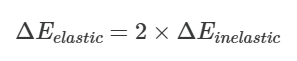
    Yep. I can see my AP Physics C and AP Physics 1 students shaking their heads in disgust at the title. The condescension that I do not know what I am talking about would also be crisp, with that all too familiar sophomore/junior energy- “K, so look, literally inelastic collisions lose energy. So if that happens twice, then

    Elastic Collisions are Two Inelastic Collisions

    Is that what you are saying? Because that violates the definition of elastic collisions-it does not lose energy. Like, literally!” And you would be right. This is absolutely not true for energy. But the context is the first word of the title- this is about momentum and by going deep into the weeds with that stuff, we’d discover something cool about energy as well!

    Collisions: a real example

    Let’s start with 1-D collisions for starters. Here’s a video of a baseball bat hitting a baseball. Although momentum isn’t conserved here (because the baseball is pivoted on end), it is a good approximation of what happens with elastic collisions.

    real life compression of seemingly rigid solid objects

    In the video above, you’d notice every collision has deformation-it just may not be detectable in real time. When two bodies collide, one transfers some or all of its momentum to the other (and vice versa), such that at one point in time- the bodies are moving together. This is all too familiar- this is similar to the final state of a perfectly inelastic collision (shown below)- but for just an instant of time.

    Inelastic collision demo

    velocity of center of mass remains unchanged

    Elastic collisions: symmetry of forces

    symmetry of deformation in an elastic collision

    Center of mass connection

    inelastic collision in the center of mass frame

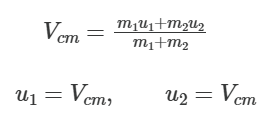
    This is even more interesting if we think of the center of mass frame. As the motion of the center of mass is unaffected by the collision (collisions are caused by internal forces only), it must mean that at the point of maximum compression (final state for inelastic collision), the two bodies must be moving with the velocity of the center of mass.

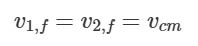
    Formulae

    That’s it. For inelastic collisions- that’s the shortcut, find the velocity of the center of mass and that is the final velocity of the objects.

    Elastic collisions, center of mass frame

    Our final analysis involves elastic collisions and how the center of mass frame analysis could be leveraged to produce a neat little shortcut for these as well. So in the center of mass frame, the velocity of both objects is zero at maximum compression.

    Formulae

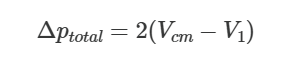
    The momentum change in the center of mass frame, then is

    Formulae
    elastic collision in the center of mass frame

    okay.

    Now this change in momentum would be repeated– because as we learned previously, the forces are symmetric in time with respect to an elastic collision. So the same forces would be applied during recoil as with the initial deformation. So,

    Formulae

    in the center of mass frame. So the final momentum is

    Formulae

    in the center of mass frame.

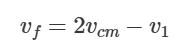
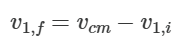
    Now, all we need to do to get this to the lab frame is to add the velocity of the center of mass to it. Voila- there you have it! The final form, and it’s deceptively simple:

    Elastic collisions, center of mass frame

    You can use this form without much thought with MCQs, but a word of warning with FRQs: AP graders might not like an equation spawned out of nowhere– you’d have to explain it.

    Final Formulae

    Inelastic collisions (1D)

    Formulae

    Elastic collisions (1D)

    Formulae

    and likewise for the velocity of the second object.

    Some honest gotchas

    The origin of these formulas is the conservation of linear momentum- plain and simple. So the old ways work, and to be fair, they’re more robust. I will spare you the derivation for 2D or 3D collisions. But there are some gotchas to this technique-it’s not universal.

    1. It does not really result in clean equations for collisions that are neither elastic nor inelastic- these would require a very clean application of momentum conservation.
    2. In 2D and higher dimensions the formulas hold only along the line of impact, and only if they are elastic or perfectly inelastic along that direction.