Year: 2026

  • Daily Habits for AP Calculus Success: What Top Students Do Differently

    Daily Habits for AP Calculus Success: What Top Students Do Differently

    Daily Habits for AP Calculus Success

    You go to class. You do the homework. You watch a study video or two when a topic gets shaky. And then a hard problem set or an FRQ lands in front of you, and it feels like you are seeing half of it for the first time.

    That is frustrating, and here is the part worth sitting with: it usually is not an effort problem. Most students who feel underprepared are putting in real time. The issue is that a lot of common study habits build familiarity rather than mastery.

    Re-reading a solved example makes calculus feel familiar. It does not make you able to solve the next unfamiliar problem cold.

    Strong AP Calculus students tend to do something different, and it is quieter than it looks. They build small, repeatable daily habits that force them to recall concepts from memory, solve problems they have not seen, catch their own mistakes, and apply the math instead of leaning on a memorized procedure.

    Habit 1: Solve Calculus Problems Every Day

    Daily problem solving keeps your skills warm. When you touch calculus every day, the patterns start to feel automatic, your hesitation drops, and unfamiliar questions stop feeling like ambushes.

    It does not take long. A realistic session looks like this:

    • 5 minutes reviewing one concept
    • 15 minutes solving three to five problems
    • 5 to 10 minutes checking and analyzing what went wrong

    Notice that the number of problems is not the point. Five problems you fully understand and review beat twenty you rush through. The review is where the learning happens, not the solving.

    Seek2Lrn Tip Pick problems that make you think in different ways rather than ten near-identical ones. Solving the same derivative pattern ten times mostly trains autopilot. A derivative problem, then a related rates problem, then a graph-reading one forces you to actually choose an approach, which is the real exam skill.

    Habit 2: Keep an Error Notebook

    If you take one thing from this article, make it this. Checking the right answer and moving on teaches you almost nothing. The mistake itself is the lesson, and most students throw it away.

    For every meaningful miss, write down:

    • The original question
    • The approach you took
    • Exactly where it went wrong
    • The correct reasoning
    • The concept involved
    • What to watch for next time

    Here is why it matters. Say you differentiate a function perfectly but misread what the derivative means in a word problem, treating a rate of change as a total amount. That is not a calculus skill gap. Your differentiation was fine. It is an interpretation gap, and it needs a completely different fix than more derivative drills. You only see that distinction when you write the mistake down and look at it.

    Seek2Lrn Tip Review your error notebook once or twice a week and hunt for patterns, not one-off slips. If the phrase “sign error” or “misread the question” shows up five times, that is your real problem, and it is a much shorter list to fix than you would expect.

    Habit 3: Stop Memorizing Formulas Without Understanding Them

    Formulas matter, but AP Calculus is built to test whether you know what the math actually represents. The exam deliberately asks the same idea in graphical, numerical, analytical, and verbal forms, so a memorized procedure with no understanding underneath falls apart the moment the question is phrased in a new way.

    Train yourself to ask, on nearly every problem:

    • What does this expression represent?
    • What is the derivative actually telling me here?
    • Why am I integrating in this situation?
    • What does my answer mean in the context of the problem?

    Take accumulation. If you understand that an integral adds up a rate to give a total, then problems about distance from velocity, or water filling a tank, or average value all become the same idea wearing different clothes. Memorize them separately and you have four things to remember. Understand the concept and you have one.

    Habit 4: Practice Free-Response Questions Regularly

    Do not save FRQs for the three weeks before May. They are half your exam score and a completely different skill from multiple choice, so treat them as their own practice track from early on.

    FRQs test whether you can show reasoning, write a clear explanation, interpret a graph, set up the right equation, use units and context, and communicate an answer someone else can follow. That is a lot of separate skills, and they only improve with reps.

    Start small. One FRQ, or even a couple of selected parts, each week is plenty at first. When official scoring guidelines are available, read them, because they show you exactly what earns points. You will often find that reasoning and correct setup score even when the final number is off, which changes how you spend your time on the real thing.

    Seek2Lrn Tip Practice explaining why your answer makes sense, not just writing the number. If you can say in a sentence what the result means in context, you understand it. If you cannot, you have found a gap worth closing before test day.

    Habit 5: Review Difficult Topics Before They Compound

    This hits BC students especially hard. BC moves faster and stacks more on top, so a small gap in an early unit can turn into a wall by the time you reach series.

    The fix is a weekly weak-topic check. Sort what you have covered into three buckets:

    1. What you can solve independently
    2. What you can solve with some help
    3. What you cannot solve on your own yet

    Then pick one item from that third bucket and give it real attention that week. You are not trying to fix everything. You are stopping one gap from becoming five.

    If you are deciding whether BC is right for you, see Should I Take AP Calculus BC?

    Habit 6: Mix Question Types Instead of Drilling One Pattern

    There is a real difference between blocked practice, where you do fifteen derivative questions in a row, and mixed practice, where you jump between types. Blocked practice feels productive because you get into a groove. That groove is the problem. You stop deciding which method to use because every question needs the same one.

    Instead, mix it up in a single session:

    • A derivative interpretation question
    • A graph analysis question
    • A related rates problem
    • A motion problem
    • An optimization question
    • A calculator-based question
    • A numerical reasoning question

    Now every problem forces a decision: which concept applies here?

    That decision is exactly what the exam demands, and it is the thing blocked practice never trains. Mixed practice feels harder and slower, and that difficulty is the point.

    Habit 7: Use Timed Practice, but Not for Every Session

    Timing matters on this exam, but rushing every study session backfires. If you always work under the clock, you never slow down enough to fix the understanding underneath your mistakes.

    Split your practice into two stages:

    Learning stage. No timer. Focus on getting it right and understanding why. This is where new skills actually form.

    Exam stage. Add time pressure and practice making quick decisions, including when to move on from a hard question. This builds the pacing and stamina the real test needs.

    Early in the year, most of your work should be untimed. As the exam approaches, shift the balance toward timed sets so speed and accuracy come together at the right moment.

    Habit 8: Ask for Help Before Confusion Becomes a Pattern

    Strong students are not the ones who never get stuck. They are the ones who notice confusion fast and deal with it before it hardens into a habit of doing something wrong.

    When you are stuck, the questions you ask matter. Push past “how do I do this?” toward:

    • Why does this method work?
    • How would I recognize this type of problem next time?
    • Where exactly did my reasoning go off track?
    • Is there another way to solve this?
    • What assumption am I making without realizing it?

    Sometimes a classmate, teacher, or a quick office-hours visit answers these. Sometimes a persistent gap calls for more structured help from a tutor who can watch your reasoning and pinpoint where it breaks. Not everyone needs that, but knowing when to reach for it is its own skill.

    If you are considering tutoring, compare the best AP tutor websites before choosing a platform.

    How Seek2Lrn Supports a Strong AP Calculus Routine

    Plenty of students build these habits on their own. Others get further with structured guidance and someone who can spot exactly where their reasoning breaks down, which is hard to see from the inside.

    Seek2Lrn is a global learning and tutoring platform that connects students with skilled tutors across academic subjects. It offers one-on-one tutoring, structured courses, and interactive group sessions, along with smart scheduling, secure payments, interactive learning experiences, and intelligent learning tools, plus access to educators around the world.

    For AP Calculus specifically, that kind of support can reinforce the habits above: a tutor can help you review mistakes with fresh eyes, build a routine that fits your schedule, work through the concepts that keep tripping you up, give feedback on your FRQ reasoning, and target your weak areas directly.

    A Simple Daily AP Calculus Checklist

    You do not need to do all of these every day. The point is a repeatable rhythm, not another source of pressure.

    • Review one concept
    • Solve several problems
    • Explain at least one answer in your own words
    • Record any important mistakes
    • Revisit one weak area
    • Spend a few minutes recalling formulas and concepts without looking
    • Ask for help if the same problem keeps reappearing

  • How to Choose an SAT Tutor: A Parent’s and Student’s Guide

    How to Choose an SAT Tutor: A Parent’s and Student’s Guide

    How to Choose an SAT Tutor

    Your child takes a practice SAT, the score comes back, and a few weak spots are obvious. So you start searching for a tutor. Within twenty minutes you have found dozens of them, plus a handful of platforms, and they all say roughly the same thing. Experienced. Top scorer. Proven results.

    Now what? Picking the first available name feels efficient, but it is a gamble. The tutor who raised one student’s score might do nothing for yours, because your student’s problems are different.

    Here is the idea worth holding onto before you hire anyone. The right SAT tutor is not simply someone who scored high on the test themselves. They need to understand the current digital exam, pinpoint your student’s specific problems, explain ideas in a way that actually lands, and build a preparation plan the student can follow. Those are four separate skills, and plenty of impressive-looking tutors are missing at least one.

    Who Needs SAT Tutoring?

    A lot of students make real progress on their own. The College Board offers strong free official preparation, including full-length adaptive practice tests in the Bluebook app and skill-based practice through Khan Academy, which remains its official partner. There is also a Student Question Bank of official questions and free small-group sessions. A motivated student with a clear plan can go a long way on those alone.

    Tutoring tends to earn its keep in specific situations:

    • The score has plateaued despite steady practice.
    • The same question types keep causing trouble.
    • Timing is a persistent problem.
    • The student does not know how to structure their prep.
    • Accountability is the missing ingredient.
    • The student simply learns better by talking through ideas with someone.
    • The test date is close and time is short.

    A simple rule: if a student has practiced consistently for a few weeks using official materials and is still stuck, or does not know what to fix next, that is the point where outside help usually pays off. If they have not really tried structured self-study yet, start there first.

    Our SAT preparation guide also covers how to structure effective self-study before hiring a tutor.

    Understand Student Needs

    This is where most families go wrong. They search for the best SAT tutor before they understand what their own student actually needs. It is like shopping for medicine before knowing the diagnosis.

    Establish a baseline first. Sit down and figure out:

    • The current practice score and the target score
    • Strengths and weaknesses in Reading and Writing
    • Strengths and weaknesses in Math
    • Whether timing is an issue
    • Which question types produce repeated errors
    • Whether test anxiety or confidence is part of the picture
    • How much time is available each week
    • The actual test date

    Once you have this, tutor selection gets dramatically easier. A student who is strong in math but keeps running out of time needs a very different tutor than one with real content gaps in algebra. The baseline tells you which kind of help to look for, so you are hiring for a known problem instead of a vague sense that scores should be higher.

    Seek2Lrn Tip Before talking to any tutor, have the student take a realistic full-length practice test in Bluebook, then keep a list of the questions they could not explain, not just the ones they got wrong. Those are different lists. A question you guessed right on but could not explain is a hidden weakness, and it tells a good tutor far more than the raw score does.

    SAT Tutor Qualifications Check

    There is no universal SAT tutor certification, so ignore anyone implying they hold some official license. Evaluate these things instead.

    Current digital SAT knowledge. The exam went fully digital, and it is adaptive and taken on Bluebook. A tutor whose experience is rooted in the old paper test may be teaching strategies that no longer apply. Ask directly how familiar they are with the current format.

    Real subject knowledge. They should understand not just the answers but the reasoning the test rewards, so they can explain why a wrong answer is wrong.

    Teaching ability. This is the one families underestimate most. A perfect SAT score proves someone can take the test. It says nothing about whether they can teach it. Those are genuinely different talents.

    Experience with different learners. The mark of a strong tutor is a second explanation, and a third, when the first one does not click. Rigid tutors teach one way and blame the student when it fails.

    Familiarity with official materials. Good tutors work from current, legitimate SAT practice, especially official College Board resources, rather than outdated or knock-off question sets.

    Tutor quality matters just as much when comparing platforms, as our Wyzant vs Preply SAT tutoring comparison shows.

    SAT Tutor Assessment

    Completing practice questions is easy. Understanding why a student keeps missing them is the actual job.

    Consider three students with similar scores:

    • Student A keeps missing linear equation questions because of a genuine content gap.
    • Student B knows the math cold but loses points to rushed, careless decisions.
    • Student C understands each question alone but gets thrown by unfamiliar wording.

    Same score, three completely different problems, three different fixes. Drilling more algebra would help Student A and do nothing for Student B. A tutor who cannot tell these situations apart will apply the same generic plan to all three.

    So look for a tutor who diagnoses before prescribing. They should be able to look at a student’s mistakes and identify the pattern underneath them.

    SAT Teaching Style

    Compatibility matters more than families expect. Tutors tend to work in different ways:

    Some explain everything thoroughly. Some push the student to reason through problems with guiding questions. Some lean heavily on practice volume. Many blend teaching with guided practice. None of these is automatically best. What matters is whether the method fits the particular student.

    A shy student who freezes under questioning might learn better with clear direct explanations at first. A student who already grasps the content but needs to build independence often benefits from a tutor who asks rather than tells, because that forces the thinking the exam demands. Watch a session or ask how the tutor adapts, and trust the student’s read on whether it clicks.

    Questions Students Should Ask a Tutor

    Students, this tutor works with you, so speak up. Ask:

    • Can you explain a hard question a different way if I do not get it the first time?
    • How will you help me with my weakest section?
    • How will we work on my timing?
    • Will I actually solve problems during sessions, or just watch you?
    • How will I know if I am improving?
    • What should I practice between our sessions?

    If a tutor makes you feel awkward for asking questions now, that will not improve once sessions start. You should feel comfortable speaking up. That comfort is part of what you are evaluating.

    When Should You Change SAT Tutors?

    Sometimes the fit is wrong, and staying out of politeness costs you time you do not have.

    Consider changing when:

    • The tutor cannot clearly explain the student’s weaknesses.
    • Sessions feel repetitive and stagnant.
    • Feedback is thin or unhelpful.
    • The tutor does not adapt as needs change.
    • Communication is consistently poor.
    • The student has stopped making meaningful progress despite real effort.

    That said, one disappointing practice test is not a reason to switch. Scores wobble. Look for a pattern across several sessions, not a single bad day.

    Seek2Lrn SAT Tutoring

    Some families prefer a platform built around personalized learning and access to educators beyond their own area. That is the space Seek2Lrn works in.

    Seek2Lrn is a global learning and tutoring platform that connects students with skilled tutors across academic subjects and other areas of learning. It offers one-on-one tutoring, structured courses, and interactive group sessions, along with smart scheduling, secure payments, interactive learning experiences, and intelligent learning tools. Because its tutors come from around the world, it can widen the pool for a student who cannot find the right fit locally.

    For an SAT student specifically, the value of any platform still comes down to the same things covered above. Does the tutor understand the current digital SAT, can they diagnose the student’s real weaknesses, do they teach in a way that works for this learner, and can they build a plan the student will follow? A platform is only as useful as the tutor match it produces, so bring the questions and checklist from this guide with you when you evaluate one.

    If you are comparing tutoring platforms more broadly, our guide to the best tutor websites is another useful starting point.

    Conclusion

    Choosing an SAT tutor is less about finding the flashiest advertisement and more about finding someone who understands where the student stands right now, identifies the real problems, and knows how to teach them. Parents, your job is to support the process without seizing control of it. Students, stay involved in the choice, because you are the one who has to work with this person week after week.

    The best decisions here happen when both of you weigh in. If you value personalized tutoring, flexible learning, and access to educators from different places, Seek2Lrn is one option worth exploring alongside others. Whatever you choose, judge a tutor by one simple principle: are they making the student more capable on their own? That is what good tutoring looks like.

  • Momentum: Elastic Collisions Are Two Inelastic Collisions

    Momentum: Elastic Collisions Are Two Inelastic Collisions

    Momentum: Elastic Collisions Are Two Inelastic Collisions

    Yep. I can see my AP Physics C and AP Physics 1 students shaking their heads in disgust at the title. The condescension that I do not know what I am talking about would also be crisp, with that all too familiar sophomore/junior energy- “K, so look, literally inelastic collisions lose energy. So if that happens twice, then

    Elastic Collisions are Two Inelastic Collisions

    Is that what you are saying? Because that violates the definition of elastic collisions-it does not lose energy. Like, literally!” And you would be right. This is absolutely not true for energy. But the context is the first word of the title- this is about momentum and by going deep into the weeds with that stuff, we’d discover something cool about energy as well!

    Collisions: a real example

    Let’s start with 1-D collisions for starters. Here’s a video of a baseball bat hitting a baseball. Although momentum isn’t conserved here (because the baseball is pivoted on end), it is a good approximation of what happens with elastic collisions.

    real life compression of seemingly rigid solid objects

    In the video above, you’d notice every collision has deformation-it just may not be detectable in real time. When two bodies collide, one transfers some or all of its momentum to the other (and vice versa), such that at one point in time- the bodies are moving together. This is all too familiar- this is similar to the final state of a perfectly inelastic collision (shown below)- but for just an instant of time.

    Inelastic collision demo

    velocity of center of mass remains unchanged

    Elastic collisions: symmetry of forces

    symmetry of deformation in an elastic collision

    Center of mass connection

    inelastic collision in the center of mass frame

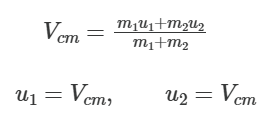
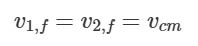
    This is even more interesting if we think of the center of mass frame. As the motion of the center of mass is unaffected by the collision (collisions are caused by internal forces only), it must mean that at the point of maximum compression (final state for inelastic collision), the two bodies must be moving with the velocity of the center of mass.

    Formulae

    That’s it. For inelastic collisions- that’s the shortcut, find the velocity of the center of mass and that is the final velocity of the objects.

    Elastic collisions, center of mass frame

    Our final analysis involves elastic collisions and how the center of mass frame analysis could be leveraged to produce a neat little shortcut for these as well. So in the center of mass frame, the velocity of both objects is zero at maximum compression.

    Formulae

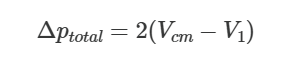
    The momentum change in the center of mass frame, then is

    Formulae
    elastic collision in the center of mass frame

    okay.

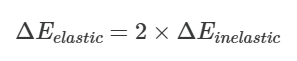
    Now this change in momentum would be repeated– because as we learned previously, the forces are symmetric in time with respect to an elastic collision. So the same forces would be applied during recoil as with the initial deformation. So,

    Formulae

    in the center of mass frame. So the final momentum is

    Formulae

    in the center of mass frame.

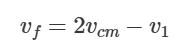
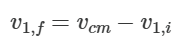
    Now, all we need to do to get this to the lab frame is to add the velocity of the center of mass to it. Voila- there you have it! The final form, and it’s deceptively simple:

    Elastic collisions, center of mass frame

    You can use this form without much thought with MCQs, but a word of warning with FRQs: AP graders might not like an equation spawned out of nowhere– you’d have to explain it.

    Final Formulae

    Inelastic collisions (1D)

    Formulae

    Elastic collisions (1D)

    Formulae

    and likewise for the velocity of the second object.

    Some honest gotchas

    The origin of these formulas is the conservation of linear momentum- plain and simple. So the old ways work, and to be fair, they’re more robust. I will spare you the derivation for 2D or 3D collisions. But there are some gotchas to this technique-it’s not universal.

    1. It does not really result in clean equations for collisions that are neither elastic nor inelastic- these would require a very clean application of momentum conservation.
    2. In 2D and higher dimensions the formulas hold only along the line of impact, and only if they are elastic or perfectly inelastic along that direction.
  • Tutor.com vs Seek2Lrn: Which Platform Is Better for AP Physics Students?

    Tutor.com vs Seek2Lrn: Which Platform Is Better for AP Physics Students?

    Tutor.com vs Seek2Lrn: AP Physics

    It is 10 p.m., you have a physics problem set due tomorrow, and you have been staring at the same rotational motion question for forty minutes. This is the moment most students realize they need help. The question is what kind.

    AP Physics has a reputation for a reason. It is one of the toughest AP subjects, and the students who do well are rarely the ones who just study longer. They are the ones who learned the material from someone who could actually explain it. So the platform you pick matters. Two names that come up are Tutor.com and Seek2Lrn, and they approach the problem very differently.

    A quick note before we start: this article is published by Seek2Lrn. We have kept the comparison honest and factual, and where we cannot verify something, we say so. You deserve a real basis for the decision.

    Why AP Physics Is Difficult

    AP Physics is not hard because the topics are obscure. It is hard because of how it asks you to think.

    The syllabus is concept-heavy. Mechanics alone covers kinematics, forces, energy, momentum, and rotation, and each topic builds on the last. Electricity and magnetism adds a whole second language of fields, potential, and circuits that feels abstract to most students the first time through.

    Then there is the math. Depending on which AP Physics course you take, you are applying algebra, trigonometry, or full calculus, often under time pressure. Knowing the physics is not enough if you freeze on the setup.

    The free response questions are where it gets real. They do not just ask for an answer. They want your reasoning, your diagram, and your justification, and the scoring rewards clear thinking as much as the correct final number. Add exam timing to all of this and you can see why so many capable students underperform. Success comes down to genuine conceptual understanding plus a lot of deliberate problem solving, not memorization.

    Many of these challenges are also covered in our guide on why most students fail AP exams and how to avoid them.

    What to Look for in an AP Physics Tutoring Platform

    Before comparing any two services, it helps to know what actually matters. A good AP Physics platform should offer:

    • Tutors who genuinely know the current AP Physics courses, not just physics in general
    • Personalized teaching that adapts to where you are struggling
    • Flexible scheduling that fits a busy student
    • Real doubt solving, not just answers handed to you
    • Practice support, ideally with free response questions
    • Some way to track progress over time
    • One-on-one attention and a pace that matches you
    • Tutor availability when you actually study

    Different platforms deliver these in different ways, which is exactly where Tutor.com and Seek2Lrn part company.

    Tutor.com for AP Physics

    Tutor.com is a well-established service, owned by The Princeton Review, built around on-demand help. Its biggest strength is availability. You can log in almost any hour, get connected to a tutor, and work through a problem in an online classroom with a shared whiteboard. For that 10pm moment, it is genuinely useful.

    The tutors are qualified, often holding advanced degrees, and the platform covers a wide range of subjects beyond physics. If your main need is quick, reliable homework help whenever it strikes, this model fits well.

    There are limitations worth understanding. You do not choose or keep a consistent tutor, so each session may be with someone new who does not know your history. That works fine for one-off questions but makes long-term, structured exam preparation harder to build. It runs on a monthly subscription, and unused hours generally expire with the billing cycle. Access is also limited to students with a US or Canadian billing address.

    One small but telling detail: parts of Tutor.com’s physics pages still reference AP Physics B, a course the College Board retired back in 2014 and replaced with AP Physics 1 and 2. It is not a dealbreaker, but if you go this route, it is worth confirming the tutor is current on the exact course you are taking.

    Best for: Students who want 24/7 on-demand help and quick answers to specific problems, especially close to a deadline.

    Seek2Lrn for AP Physics

    Seek2Lrn takes a different approach, built around a continuing relationship rather than one-off sessions. The idea is simple: you learn physics better from a tutor who knows you, tracks your progress, and shapes each session around your specific weak spots.

    The platform focuses on personalized, one-on-one tutoring with experienced educators, flexible scheduling, and interactive online sessions. Because it connects students with tutors globally, it is designed to reach learners regardless of location, which matters for international students who often get left out of US-only services. A free demo session lets you test the fit before committing, and the model centers on student-focused, technology-enabled learning rather than rapid-fire homework help.

    In fairness, Seek2Lrn is a newer and smaller platform than Tutor.com, without the decades-long track record of a Princeton Review service. What it offers instead is continuity and personal attention. If you want the same tutor building your understanding over weeks, that is the trade the model is designed around.

    Best for: Students who want consistent, personalized guidance and a tutor who stays with them through the course.

    You can also follow our complete guide on how to prepare for AP Physics C for a structured study plan.

    Side-by-Side Comparison

    Factor Tutor.com Seek2Lrn
    Personalization Session-based, varies by tutor Built around a consistent, matched tutor
    Tutor Matching Auto-connected to whoever is available Matched to goals, needs, and schedule
    Flexibility 24/7 on-demand access Scheduled sessions, flexible booking
    Student Support Quick homework and concept help Ongoing, relationship-based guidance
    Learning Experience Online classroom, per-session Interactive one-on-one, continuous
    Scheduling Any time, no appointment Booked around student and tutor
    Best For On-demand help and deadlines Structured, long-term improvement

    Neither is simply better. They solve different problems. One is a fast answer at midnight. The other is a steady climb over a semester.

    Seek2Lrn Tips for AP Physics Success

    This is the part that helps you no matter which platform you choose, or even if you choose neither. These habits move AP Physics scores more than any subscription does.

    Build the concept before touching the formula. Most students memorize equations and then hunt for one that fits. Flip it. Understand what is physically happening first, and the right equation becomes obvious. A good tutor drills this by asking you to explain a situation in words before you write anything down.

    Keep an error notebook. For every problem you miss, write the mistake in a few words. Sign error. Wrong free-body diagram. Forgot to resolve the vector. After a month, your personal pattern appears, and it is almost always a short list you can fix.

    Do free response questions every week. FRQs are half the exam and the best test of real understanding. Working official past questions against the scoring guidelines teaches you what actually earns points, which is often reasoning, not just the final answer.

    Mix conceptual and numerical practice. The exam does both, so your practice should too. Alternate between “explain why this happens” and “calculate the value” so neither skill goes rusty.

    Chase the why, not the answer key. Checking that you got the right number teaches you almost nothing. Understanding why it is right, and why the other approach failed, is where the learning lives.

    Revise formulas by using them. Do not reread a formula sheet. Rederive or apply the key equations in problems, since that is how they actually stick.

    Ask questions out loud during sessions. The point of a live tutor is real-time doubt solving. If something is fuzzy, stop and ask. This is exactly where personalized tutoring beats a video: a tutor can catch the specific thing confusing you and rephrase it until it clicks.

    Practice under exam timing. Do full timed sections before test day. Physics you can solve slowly is not the same as physics you can solve in the minutes the exam gives you.

    Which Platform Should You Choose?

    Be honest about how you learn and what you need right now.

    If your struggles are occasional, you value round-the-clock access, and you mostly want help getting unstuck on specific problems, Tutor.com’s on-demand model fits well and its availability is hard to beat.

    If you want a tutor who knows you, builds a plan around your gaps, and stays with you through the course, a relationship-based platform like Seek2Lrn suits that goal better. International students in particular may find its global, personalized setup more accessible than US-only services.

    Budget, schedule, and how much continuity you want should drive the decision more than any single feature.

    Still exploring your options? Compare the best AP tutor websites before making a decision.

    Final Thoughts

    There is no universal best AP Physics tutor, only the one that fits how you study. Tutor.com is a strong, proven option for on-demand help, and plenty of students get real value from it.

    For students who want personalized guidance, flexible scheduling, one-on-one attention, and steady improvement over time, Seek2Lrn is worth considering as an alternative built around exactly those things. Take the free demo, try a session, and see whether the fit feels right before you commit. The best tutor is the one who leaves you able to solve the next problem on your own.

  • Wyzant vs Varsity Tutors vs Seek2Lrn: Which Platform Is Better for AP Calculus?

    Wyzant vs Varsity Tutors vs Seek2Lrn: Which Platform Is Better for AP Calculus?

    Wyzant vs Varsity Tutors vs Seek2Lrn

    Finding an AP Calculus tutor sounds simple until you actually start looking. Within an hour you are staring at a dozen platforms, wildly different prices, and a hundred tutor profiles that all promise the same results. How are you supposed to know which one will actually help your student score a 4 or a 5?

    The stakes are real. AP Calculus builds relentlessly, where each topic leans on the one before it, so a student who falls behind in September is often lost by November. The right tutor catches those gaps early and keeps a student on pace. The wrong platform wastes months and money you will not get back before the May exam.

    This is an honest look at three options that work very differently. One note up front: this article is published by Seek2Lrn, which is one of the three. We have kept the comparison factual and flagged anything we cannot verify.

    What Makes a Good AP Calculus Tutoring Platform?

    Before comparing any service, know what actually matters. Price and tutor count are easy to see. These are the things that decide whether tutoring works.

    Tutor expertise in AP specifically. A brilliant mathematician who has never taught the exam is not the same as an AP Calculus specialist who knows the pacing and the scoring.

    AP curriculum familiarity. The tutor should know the difference between AB and BC cold, and understand how the free response section is graded.

    Personalized teaching. Calculus struggles are individual. One student’s problem is limits, another’s is series. Good tutoring targets your specific gap.

    Practice resources and progress tracking. You want past exam questions, timed practice, and some honest signal of whether you are improving.

    Scheduling flexibility and budget fit. The best tutor in the world is useless if they teach when you are in school or cost more than you can sustain for months.

    Seek2Lrn Tip Whatever platform you pick, ask a prospective tutor to tell you the difference between how AB and BC handle a specific topic, like series or the fundamental theorem. A real AP specialist answers instantly and specifically. A general math tutor hesitates. This one question filters out most of the wrong fits in under a minute.

    If you are still deciding between the two courses, our guide on Should I Take AP Calculus BC can help you understand which option is the better fit.

    Wyzant for AP Calculus

    Wyzant is a marketplace. Instead of being assigned a tutor, you browse profiles, read verified reviews, compare rates, and choose your own. You can keep that same tutor for the whole course, which matters a lot for a subject that builds on itself.

    Advantages. The selection is deep, with many tutors who specialize in AP Calculus and show documented score improvements in their reviews. Pricing is transparent and pay-as-you-go, with no subscription. Most tutors charge around $35 to $65 an hour, though sought-after AP Calculus specialists can run higher, into the $80 to $120 range. Your first hour with a new tutor is protected by the Good Fit Guarantee, so a bad match will not cost you.

    Limitations. Because anyone can list, quality varies, and you do the vetting yourself. Parents often report it takes two or three tries to find the right tutor.

    Who should consider it. Students and parents who want control over who they hire and prefer to pay only for the sessions they use.

    Seek2Lrn Tip On any marketplace, do not just read the star rating. Read the actual review text and look specifically for AP Calculus mentions and score outcomes. A tutor with a 5-star average from general math students tells you little about how they handle the AP exam. Filter for reviews that name the test.

    Varsity Tutors for AP Calculus

    Varsity Tutors uses a managed model. Rather than making you search, the platform matches you with a tutor based on your goals, then supports the relationship with its own learning platform, apps, and practice tools. It offers one-on-one tutoring alongside small group classes and self-study resources.

    Advantages. The matching is hands-off, which some families prefer, and tutors are credentialed instructors. The live learning platform is polished, with recorded sessions and progress features. There is a real structure here, closer to a program than a loose marketplace.

    Drawbacks. It sits at the premium end. Sessions generally run about $81 to $99 an hour, and packages typically require upfront payment, which is a bigger commitment than pay-as-you-go. For families needing regular sessions over months, that cost adds up quickly.

    Who benefits most. Students who want a guided, structured experience and would rather have the platform pick the tutor than sift through profiles themselves, and who have the budget for it.

    Seek2Lrn Tip AP Calculus rewards doing over watching. Whichever platform you choose, commit to working real free response questions from past exams every single week, then review them against the official scoring guidelines. Students who only watch a tutor solve problems often freeze on a blank page. The skill you need is producing solutions, not following them.

    Wyzant vs Varsity Tutors: How the Differences Actually Affect You

    On paper both offer qualified tutors and online sessions. In practice they feel different.

    Control versus convenience. Wyzant hands you the wheel. You pick, you vet, you decide. Varsity Tutors drives for you and matches you to someone. If you like researching and want the exact tutor you chose, Wyzant fits. If you would rather hand that work to the platform, Varsity Tutors does that.

    Pricing structure. This is the big practical gap. Wyzant is pay-per-session with no lock-in, so you can do one session or twenty. Varsity Tutors leans toward packages paid upfront, which costs more and commits you earlier, though it also creates a structured plan.

    Consistency. On Wyzant, quality depends entirely on the tutor you picked, so a great choice means a great experience and a rushed choice can disappoint. Varsity Tutors aims for more standardized quality through its vetting, which trades some ceiling for a more predictable floor.

    Best use cases. Wyzant suits the self-directed family that wants a specific specialist at a controllable cost. Varsity Tutors suits the family that wants a done-for-you program and will pay a premium for it.

    Which Students Should Choose Wyzant?

    Picture a student who is strong but stuck on one unit, say integration techniques, and their parent is comfortable reading reviews to find a specialist. They want eight focused sessions, not a long program, and they want to control the spend. Wyzant is a natural fit. It is also a good fit for students who have found a specific, highly rated AP Calculus tutor and want to book them directly.

    Which Students Should Choose Varsity Tutors?

    Picture a busy family that does not want to spend a weekend comparing tutor profiles and would rather the platform handle matching and structure. The student needs steady, ongoing support and the budget is there. Varsity Tutors fits that preference for a guided, managed experience. It also suits students who like having group classes and app-based practice bundled alongside private sessions.

    Another Option Worth Considering: Seek2Lrn

    If neither model feels right, it is worth knowing there is a middle path. Some students do not want to vet strangers on a marketplace, but also do not want to prepay for an expensive package.

    Seek2Lrn is built around personalized tutor matching and one-to-one learning, with flexible scheduling rather than fixed packages. It connects students with educators globally, which widens access for learners who cannot find an AP Calculus specialist locally, including international students. The emphasis is on a learner-focused, technology-assisted experience with a free demo session so you can test the fit before committing.

    To be straight with you, Seek2Lrn is a newer and smaller platform than the two established names above, without their long public track record. What it offers is a personalized, flexible model for students who want a consistent tutor without a heavy upfront commitment. Whether that fits depends on what you value.

    Final Thoughts

    There is no single perfect AP Calculus tutoring platform. The right choice depends on your learning style, your budget, your academic goals, and the kind of experience you want.

    If you want control and pay-as-you-go pricing, Wyzant is strong. If you want a structured, managed program and can afford the premium, Varsity Tutors delivers that. And if you want personalized, flexible one-to-one learning without a big upfront package, Seek2Lrn is worth exploring alongside them.

    Try a session before you commit on any of them. The best platform is simply the one whose tutor leaves your student able to solve the next problem alone.

    Choosing the right tutor is only part of success. Understanding why students fail AP exams can help you avoid the study habits that hold many students back.

  • How to Choose the Right AP Chemistry Tutor

    How to Choose the Right AP Chemistry Tutor

    Choose the Right AP Chemistry Tutor

    Most advice on this topic tells you to check credentials, read reviews, and find someone experienced. That advice is not wrong. It is just useless, because every tutor looks good on paper and every tutor has a few nice reviews.

    The families who end up disappointed usually did all of that correctly. They hired a chemistry PhD with great feedback, and three months later the student was still scoring a 2 on practice FRQs.

    What follows is the stuff nobody puts in these articles. How to tell in one session whether a tutor can actually teach this specific exam, what to ask before you pay anyone, and the moment you should walk away.

    Why the Stakes Are Higher Than People Realize

    AP Chemistry is regularly ranked among the hardest AP courses, and alumni put its difficulty around 7.3 out of 10.

    Here is the part that surprises people. The 2025 pass rate was roughly 78%, which is actually the highest of any science AP. So passing is not really the problem. Only about 18% of students score a 5.

    Read those two numbers together and the picture gets clear. The difficulty in AP Chemistry does not live between failing and passing. It lives in the gap between a 3 and a 5. That gap is almost entirely about skill, not knowledge, and it is exactly the gap a good tutor closes. A mediocre tutor will happily walk you to a 3 and call it a win.

    AP Chemistry Is Not Regular Chemistry Tutoring

    This is where most tutor searches go wrong. Parents hire a chemistry expert when they need an AP Chemistry expert. Those are different jobs.

    The exam punishes things regular chemistry never tests. Consider one detail most people never learn until it is too late: calculators are not permitted on the multiple choice section. You get 60 questions in 90 minutes doing stoichiometry, pH estimates, and unit conversions by reasoning and mental math. Calculators are only allowed on the free response section.

    A university-level chemist who has never taught this exam will not train you for that, because in their world you always have a calculator. They will teach the chemistry beautifully and leave you unprepared for the actual test.

    The FRQs stack skills in a way coursework does not. Section II gives you seven free response questions in 105 minutes. A single question might ask you to run a calculation, explain what is happening at the particle level, draw it, and justify your reasoning in writing. Knowing the content is maybe half of it. The rest is knowing what earns points.

    The hard units are predictable. Chief Reader reports consistently point to equilibrium and the thermodynamics-plus-electrochemistry combination as where students lose the most points. Acids and bases, with buffers, titration curves, and ICE tables, is where most students say the course finally got hard. A tutor who has taught this exam knows this map. One who has not will pace the year evenly and hit Unit 8 with no time left.

    Seek2Lrn Tip Ask any prospective tutor this: how do you prepare a student for the no-calculator multiple choice section? If they seem surprised by the question, they have not taught this exam recently. It is a thirty-second filter that eliminates half of the wrong candidates.

    What Real AP Chemistry Expertise Looks Like

    Forget years of experience as your main filter. Someone can teach badly for fifteen years. Look for these instead.

    They talk about scoring rubrics, not just chemistry. Strong AP tutors reference the official scoring guidelines naturally, because they know a correct answer with the wrong units or missing sig figs still loses the point. That vocabulary is a tell. It means they have graded or studied real student responses.

    They can name where students lose points. Ask where most students bleed marks. A specialist answers instantly and specifically, something like justification writing or Q versus K reasoning. A generalist says something vague about studying harder.

    They teach problem deconstruction. Acing this exam is not just comprehension. It is looking at a problem you have never seen and figuring out which concept applies. Ask a tutor how they teach that skill. The good ones have a method. The rest will not understand the question.

    They know the released materials. Every past FRQ from the last decade is publicly available with scoring guidelines and chief reader reports. A serious AP Chemistry tutor works from these constantly.

    Seek2Lrn Tip Compare how tutors teach, not how long they have taught. Two tutors with identical résumés can produce completely different results, and the difference shows up in a single session, not in a bio.

    The Trial Lesson: A Practical Test

    A trial lesson is not a meet and greet. It is an audition, and you should run it like one.

    Bring a real FRQ. Pull an official free response question from a past exam, ideally on equilibrium or acids and bases. Hand it over and ask them to teach it live.

    Then watch for these things.

    1. Do they ask what you already know before explaining? Good tutors diagnose first. Weak ones start lecturing immediately.
    2. Do they explain why, or just how? Anyone can walk through steps. You want the tutor who tells you why an ICE table works, because that transfers to problems you have not seen.
    3. Do they let you struggle for a moment? The best tutors leave a little silence and let you attempt the next step. Tutors who rush to fill every gap feel great in the moment and teach very little.
    4. Do they check whether it landed? Watch for them asking you to explain it back. Explanation without verification is a lecture, not tutoring.
    5. Do they mention what earns points? For an FRQ, a specialist will naturally point out what the rubric rewards.

    Seek2Lrn Tip Ask the tutor to explain one AP Chemistry FRQ live during the trial lesson, then ask yourself one question afterward: could you now solve a similar problem alone? If the answer is no, it does not matter how impressive the explanation sounded.

    Warning Signs Worth Taking Seriously

    Some of these look harmless at first.

    • They re-teach your class lecture. If sessions feel like a slower version of school, you are paying for repetition, not instruction.
    • They do the problems for you. It feels productive. It builds nothing.
    • They never assign anything between sessions. Chemistry improves through independent practice. A tutor who never sends you off with work is not tracking your progress.
    • They avoid timed practice. Students who regret taking AP Chem are almost always the ones who did not practice under timed conditions until the last few weeks. A good tutor pushes timed FRQs early.
    • They cannot tell you what you are bad at. After three or four sessions, a tutor should be able to name your specific weaknesses precisely. Vagueness here means they are not paying attention.
    • They promise a 5. Nobody can promise that. It is a sales tactic.

    Online or In-Person?

    The honest answer is that it matters far less than the tutor.

    Online widens your pool enormously, which matters because AP Chemistry specialists are genuinely rare. Your town might have three chemistry tutors and none who have taught this exam. Online, you can find someone who has taught it for a decade.

    In-person can help students who need physical accountability. But the format is not what moves your score. The person is.

    How to Tell If It Is Actually Working

    Set this up before you start, not after you are frustrated.

    Take a timed practice section in week one and write down the score. That is your baseline. Then track two things: your practice FRQ scores against the official rubric, and the kind of mistakes you make.

    That second one matters more. Early on, mistakes should be conceptual. Later, they should shrink to careless errors. If you are making the same conceptual mistake in week eight that you made in week two, the tutoring is not working, regardless of how pleasant the sessions feel.

    Give it three sessions minimum before judging, and no more than six before deciding.

    Seek2Lrn Tip Review your first three sessions before committing long term. Ask yourself whether you are solving problems more independently than you were, not whether you understood the tutor’s explanations. Understanding someone else’s reasoning is easy. Producing your own is the whole exam.

    Final Checklist

    Before you commit, confirm:

    • They have taught AP Chemistry specifically, not just chemistry
    • They can explain the no-calculator MCQ strategy
    • They reference official scoring rubrics naturally
    • They name your weak areas specifically after a few sessions
    • They assign work between sessions
    • They use released FRQs and timed practice
    • You can solve problems alone after sessions, not just follow along
    • They diagnosed before they taught
    • They make no score guarantees

    Finding Someone Who Actually Fits

    Knowing what to look for is most of the work. The harder part is finding a tutor who genuinely has these qualities and is available when you can study.

    That gap is worth naming. A tutor who checks every box but only teaches at 3 p.m. on weekdays is not a match for a student with a full schedule. Fit is not just expertise; it is expertise you can actually access, at a level that matches where you are.

    Seek2Lrn is built around that problem. It connects students with qualified tutors based on learning goals, schedule, teaching preferences, and academic needs, rather than leaving you to sift through profiles and hope. If you are looking for AP Chemistry help, it is worth exploring, ideally with the questions above in hand.

    Use them on any tutor you consider, including ours. A tutor who is genuinely good at this will welcome the scrutiny.

  • Should I Take AP Calculus BC?

    Should I Take AP Calculus BC?

    You’re staring at next year’s course selection sheet, and there it is. AP Calculus BC. You like math, mostly. You did fine in Precalculus. But you’ve heard things. Someone’s older sibling said it wrecked their GPA. Your counselor says you’d be fine. Your friend is signing up and wants you to join.

    So which is it? Is this the class that opens doors, or the one that quietly eats your senior year?

    Here’s the honest answer nobody gives you upfront: it depends far less on how smart you are than on what you’re walking in with and what else is on your plate. Let’s figure out where you actually stand.

    What Is AP Calculus BC?

    AP Calculus BC covers everything in AP Calculus AB, then keeps going. Think of AB as the first semester of college calculus and BC as the first two semesters compressed into one high school year.

    You’ll work through limits, derivatives, integrals, and their applications, which is the AB core. Then BC adds parametric equations, polar coordinates, vector-valued functions, and infinite series, including Taylor and Maclaurin series.

    The pace is the real story. Same school year, noticeably more material. Teachers don’t slow down much, because they can’t. If you miss a week, catching up is genuinely hard, since almost every topic leans on the one before it.

    One detail worth knowing early: the BC exam gives you an AB subscore alongside your BC score. So if BC-only topics like series give you trouble but your fundamentals are solid, you can still walk away with AB credit. That safety net is real, and a lot of students don’t realize it exists.

    Who Should Take AP Calculus BC?

    You’re likely a good fit if most of this sounds like you.

    Your algebra is genuinely strong. Not “I passed,” but strong. Calculus is mostly algebra wearing a new hat. Every derivative and integral problem ends with manipulation you learned years ago. Students who are shaky here don’t fail because calculus is hard. They fail because they’re fighting two battles at once.

    Precalculus felt manageable. Trig identities, function behavior, and logarithms should feel familiar rather than frightening. Unit circle values in particular show up constantly.

    You’re heading toward STEM. Engineering, physics, computer science, math, economics. BC lines up directly with what you’ll take freshman year.

    You actually like hard problems. Not that you always solve them, but that a tricky problem makes you lean in rather than shut the book.

    You want the college credit. BC often earns credit for two semesters instead of one, which can save real money and free up your schedule later.

    ⭐ Seek2Lrn Tip Before you commit, pull up a Precalculus final from last year and redo ten problems cold, without notes. Not to check whether you can eventually solve them, but to see how fast and how automatically the algebra comes back. BC’s difficulty isn’t in learning new ideas. It’s in doing old algebra quickly while learning new ideas on top of it. If those ten problems feel slow, you’ve found your summer project, and that’s genuinely useful information rather than a reason to back out.

    Who Should Think Twice Before Taking It?

    None of this means you’re not capable. It usually means the timing or the setup is wrong.

    Your math foundation has gaps. If Precalculus was a grind and you’re still uneasy with trig or logs, BC will expose that fast. Taking AB first isn’t a downgrade. It’s often the smarter path to the same destination, and plenty of strong engineers took AB.

    Your schedule is already full. Four other APs, a sport, a job, applications? BC needs consistent weekly hours, not heroic cramming. Something has to give, and it’s usually your sleep or another class.

    STEM isn’t your direction. If you’re headed toward humanities, business, or the arts, AB or AP Statistics may serve you better and still look strong on an application. Statistics is arguably more useful for a psychology or business major than series ever will be.

    You’re taking it because your friends are. This is the one that stings. Your friend’s math background isn’t yours, and their schedule isn’t yours. Choosing a course to stay in a group is how good students end up miserable in February.

    AP Calculus BC vs AP Calculus AB

    Feature AP Calculus AB AP Calculus BC
    Difficulty Challenging but paced Same content, faster, plus more
    Topics Limits, derivatives, integrals, basic differential equations All of AB plus parametric, polar, vectors, infinite series
    Workload Steady; roughly 4 to 6 hours weekly Heavier; roughly 6 to 10 hours weekly
    College Credit Usually one semester of calculus Often two semesters, plus an AB subscore
    Best For Solid math students, non-STEM majors, anyone wanting depth over speed STEM-bound students with strong algebra and room in their schedule

    Worth noting: BC’s score distribution looks better than AB’s, with roughly 43% earning a 5 compared to about 20% for AB. That doesn’t mean BC is easier. It means the students who take BC tend to be the ones who already had strong foundations and self-selected in.

    How Difficult Is AP Calculus BC Really?

    Ask around online and you’ll get two answers that seem to contradict each other. Half the students say it was the hardest class they took. The other half say it was overhyped and the AP exam was easier than their teacher’s tests.

    Both are telling the truth, and the difference between them is rarely intelligence.

    The struggles cluster in predictable places. Infinite series is the wall. It’s abstract in a way nothing before it was, and it arrives late in the year when everyone’s tired. Related rates and optimization trip people up too, mostly because they require translating words into equations.

    Time commitment is real. Most students report needing several hours a week outside class, consistently, not in bursts. AP courses generally expect roughly as much work outside class as inside it, and BC sits at the demanding end.

    Your teacher matters more than anyone admits. This comes up constantly in student discussions. The same course can feel completely different depending on who’s teaching it. If you can ask upperclassmen about your specific teacher, do it. That’s better intel than any national statistic.

    Consistency beats intensity. Students who do problems most days handle series fine when it arrives. Students who cram before tests hit Unit 10 with a shaky foundation and panic.

    Here’s the pattern underneath all of it: students who struggle in BC are usually underprepared, not incapable. The gap is almost always algebra fluency or precalculus recall, not some missing math gene. That’s genuinely good news, because preparation is fixable and talent isn’t a thing you can order.

    ⭐ Seek2Lrn Tip When you get a problem wrong, write down why in four words or less. Sign error. Forgot chain rule. Misread the question. Do this for a month and a pattern appears that you cannot see any other way. Most students review the correct solution and move on, which teaches them almost nothing. The mistake itself is the lesson, and BC punishes repeated small errors far more than it punishes not knowing a concept.

    Benefits of Taking AP Calculus BC

    Let’s be measured about this. BC isn’t magic, but the upsides are real.

    You can earn credit for two semesters of college calculus with a strong score, which saves tuition and opens schedule space. You’ll walk into a STEM major already having seen the material once, which makes freshman year meaningfully less brutal. Engineering and computer science both lean on calculus quickly, and having it in your hands helps.

    There’s also something less measurable. Working through a genuinely hard course builds mathematical maturity, meaning you get better at sitting with a problem you can’t immediately solve. That skill transfers to everything.

    One caveat worth checking: credit policies vary by school. Some require a 4, others a 5, and a few give less credit than you’d expect. Look up your target schools before assuming.

    Questions You Should Ask Yourself Before Enrolling

    Be honest. Nobody’s reading your answers.

    • Do I actually enjoy solving math problems, or do I just tend to do well in math?
    • Can I redo Precalculus problems quickly and confidently right now?
    • Do I have six or more hours a week for this class specifically?
    • How many other APs am I taking, and is that realistic?
    • Am I choosing this for my goals or someone else’s?
    • Would I actually ask for help in October, or would I quietly fall behind until December?
    • Do my target colleges give meaningful credit for BC?
    • Would AB get me where I’m going with less strain?

    That sixth question matters more than it looks. The students who do well in BC aren’t the ones who never struggle. They’re the ones who ask early instead of hoping it clicks.

    Final Thoughts

    Not everyone should take AP Calculus BC, and that’s completely fine. It’s a course, not a verdict on your ability.

    If your algebra is solid, you’re STEM-bound, and you have room in your schedule, BC is a strong choice that pays off in credit and readiness. If your foundation is shaky or your year is already packed, AB is a genuinely good option that leads to the same places, often with better results and a happier you.

    The students who thrive in BC aren’t the naturally gifted ones. They’re the prepared ones who stayed consistent and asked for help when they hit a wall. That’s it. That’s the whole secret.

    About Seek2Lrn

    If you’re still unsure whether AP Calculus BC matches your current skill level, talking with an experienced tutor can make the decision much clearer. Seek2Lrn connects students with qualified tutors who can look at where your math foundation actually stands, walk you through what BC will ask of you, and help you shore up algebra or precalculus gaps before the school year starts. Sometimes one honest conversation with someone who knows the course saves you a whole semester of guessing.

  • How to Prepare for the ACT (2026 Guide)

    How to Prepare for the ACT (2026 Guide)

    Dive Deep into How to Prepare for the ACT

    Getting ready for the ACT can feel like a lot, especially now that the test itself has changed. The good news is that a shorter, more flexible exam actually plays to your advantage if you prepare the right way. A strong ACT score still carries real weight with colleges, and with several universities bringing back testing requirements, that score can be the difference between a maybe and a yes.

    Here is the thing most students miss. Improving your ACT score is not about grinding for more hours. It is about knowing exactly what the test asks, where you lose points, and how to fix those gaps with a plan you can stick to. This guide walks you through all of that, step by step, using the current 2026 format.

    What Is the ACT and Why Does It Matter?

    The ACT is a standardized test colleges use to measure how ready you are for university coursework. It gives admissions teams a common way to compare students from very different high schools.

    The exam now has three core sections that count toward your main score: English, Math, and Reading. Science is still available but optional, and the Writing essay remains optional too.

    Your composite score runs from 1 to 36 and is the average of your English, Math, and Reading section scores. That 1 to 36 scale has not changed, so a 30 today means what a 30 always meant.

    Universities still value ACT scores because they predict college readiness and help with merit scholarships. Some schools have moved back to requiring test scores after years of test-optional policies, so a solid ACT can strengthen your application and, in some cases, save your family real money on tuition.

    Takeaway: The ACT still matters, and the core score now rests on just three sections. Know which sections your target colleges want before you register.

    Understand the ACT Format Before You Start Studying

    The 2025 redesign, often called the enhanced ACT, made the test shorter and gave you more time per question. Here is how it breaks down now.

    Section Questions Time Skills Tested
    English 50 35 min Grammar, punctuation, sentence structure, editing
    Math 45 50 min Algebra, geometry, functions, data (now 4 answer choices)
    Reading 36 40 min Comprehension, main idea, evidence, inference
    Science (Optional) 40 40 min Reading charts, graphs, experiments, data analysis
    Writing (Optional) 1 Essay 40 min Argument, organization, clarity

    A few points worth knowing. The core exam of English, Math, and Reading takes about 2 hours and 5 minutes, down from roughly 3 hours on the old test. Math questions now give you four answer choices instead of five, which slightly improves your odds on a guess. Passages in English and Reading are shorter. And there is no penalty for wrong answers anywhere on the ACT, so never leave a bubble blank.

    If you take the optional Science section, you stay after Reading for an extra 40 minutes, and it appears as a separate score plus a STEM score that averages Math and Science. It does not touch your composite.

    Takeaway: More time per question means the enhanced ACT rewards careful, methodical work over speed guessing. Decide early whether Science makes sense for your schools.

    How Early Should You Start Preparing for the ACT?

    The right timeline depends on your starting point and target score. Here are three realistic options.

    • Six-month plan: The most comfortable pace. Spend the first two months on fundamentals, the middle two on targeted practice and strategy, and the last two on full practice tests and fine-tuning. Best if you are balancing prep with a heavy school load.
    • Three-month plan: A focused, workable timeline. Weeks 1 to 4 for format and weak fundamentals, weeks 5 to 8 for timed section practice, weeks 9 to 12 for full tests and mistake review.
    • One-month crash plan: Tight but doable if you already have a decent base. Prioritize your two weakest sections, take a full practice test each week, and drill the question types that cost you the most points. Skip trying to master everything and aim for the highest-value fixes.

    Takeaway: Start as early as you reasonably can. Even 45 focused minutes a day over months beats a frantic final week.

    Step-by-Step ACT Preparation Plan

    Take a Diagnostic Test

    Before you study anything, sit one full-length practice test under real timing. This gives you a baseline score and, more importantly, shows you exactly which sections and question types are dragging you down. Do not skip this. Studying without a diagnostic is like training for a race without knowing how far you can currently run.

    Seek2Lrn Tip: A tutor can read your diagnostic results far faster than you can alone. Instead of guessing where you are weak, personalized tutoring pinpoints the specific skills costing you points, so your very first study sessions target what actually moves your score.

    Create a Study Schedule

    Turn your timeline into a weekly rhythm you can follow. A simple sample week might look like this:

    • Monday: English grammar drills, 45 minutes
    • Tuesday: Math practice on your weakest topic, 60 minutes
    • Wednesday: Reading passages with timing, 45 minutes
    • Thursday: Review the week’s mistakes, 45 minutes
    • Friday: Light Science or vocabulary practice, 30 minutes
    • Weekend: One timed section or, later on, a full practice test

    Keep the sessions at fixed times so studying becomes a habit instead of a daily decision.

    Seek2Lrn Tip: A generic schedule treats every student the same, but you are not average in every section. A customized learning plan puts more hours where your gaps are and less where you are already strong, which is why tailored plans tend to raise scores faster than one-size-fits-all templates.

    Master the English Section

    English rewards knowing a handful of rules that repeat constantly: subject-verb agreement, commas and semicolons, sentence boundaries, and clear, concise phrasing. When a shorter answer says the same thing cleanly, it is usually right.

    Seek2Lrn Tip: Read a little every day with an editor’s eye. Notice how sentences are punctuated and where clauses break. Building that instinct through daily reading makes the grammar questions feel obvious instead of tricky by the time test day arrives.

    Improve Your Math Skills

    ACT Math covers algebra, geometry, functions, and some data analysis. Learn the formulas you are expected to know by heart, since the ACT does not give you a formula sheet. Practice the topics that appear most, and use the new four-choice format to your advantage when you need to estimate or eliminate.

    Seek2Lrn Tip: One confusing concept can block an entire question type. One-on-one guidance helps here because a tutor can rephrase a tough idea in a way that finally clicks for you, then give you targeted problems until it sticks, which is hard to replicate with a textbook alone.

    Build Strong Reading Skills

    The Reading section is a race against the clock, so pacing is everything. Read the question first when it points to a specific detail, find the relevant lines, and answer from the text rather than memory. With shorter passages now, active reading matters more than speed-skimming.

    Seek2Lrn Tip: To read faster without losing comprehension, practice summarizing each passage in one sentence right after you read it. Guided practice on this habit trains you to grab the main idea quickly, which is exactly what most Reading questions reward.

    Prepare for the Science Section

    If you opt in, Science is less about knowing facts and more about reading data. Most questions can be answered straight from the charts, graphs, and experiment descriptions in front of you. Learn to find the trend, match it to the question, and move on. Data analysis passages are usually the fastest, so start there.

    Seek2Lrn Tip: Interpreting graphs gets much easier with structured practice. A tutor can walk you through how to spot variables, trends, and relationships in seconds, turning a section that looks intimidating into one of your steadier scores.

    Take Full-Length Practice Tests

    Nothing prepares you like the real thing. Full tests build the stamina and pacing that short drills cannot, and they get you used to the timing of the enhanced format.

    Seek2Lrn Tip: Simulated exams under real conditions do two things at once. They sharpen your time management and they lower test-day anxiety, because by the time you sit the real ACT, the format and pacing already feel familiar and routine.

    Top ACT Preparation Mistakes to Avoid

    A few common habits quietly cost students points:

    • Studying without a schedule: Random effort spreads you thin and leaves gaps.
    • Ignoring weak areas: Practicing what you are already good at feels nice but barely moves your score.
    • Taking practice tests without reviewing them: The score means little if you do not study why you missed each question.
    • Poor time management: Even with more time now, running out on a section tanks your accuracy. Practice pacing.
    • Not understanding the exam pattern: Walking in unfamiliar with the format wastes energy you should spend on questions.

    Takeaway: Most of these mistakes trace back to one root cause, which is prepping without a clear plan. Fix that and the rest tend to fall into place.

    Best Resources for ACT Preparation in 2026

    You do not need a mountain of materials. A few strong ones do the job:

    • Official ACT resources: The Official ACT Prep Guide 2025-2026 and the free digital practice test on the ACT website use the current enhanced format, so they match what you will actually see.
    • Practice books: A current-edition prep book from a trusted publisher gives you structured content review, as long as it reflects the new format.
    • Online resources: Free question banks and drill apps are great for short daily practice between longer sessions.
    • Tutoring support: When you plateau or keep missing the same things, a tutor gives you feedback and a plan built around your gaps.
    • Study groups: Working with a few motivated peers keeps you accountable and lets you learn from how others approach tricky questions.

    Takeaway: Prioritize official, format-accurate materials first. Old practice tests still teach the content, but adapt their timing to the shorter sections.

    One Week Before the ACT Exam

    The final stretch is about staying sharp and calm, not cramming new material:

    • Sleep: Start sleeping well several nights ahead, not just the night before. A rested brain scores higher.
    • Revision: Review your mistake notes and weakest topics with light practice. Avoid heavy new studying.
    • What to bring: Your admission ticket, a photo ID, an approved calculator, pencils, and a snack for the break.
    • Test day strategy: Pace yourself section by section, answer every question since there is no wrong-answer penalty, and flag hard ones to revisit.
    • Stress management: Do something relaxing the day before and stop studying early. Trust the work you have already put in.

    Takeaway: The week before is for confidence and rest. You cannot cram an ACT score, but you can protect the one you have earned.

    Final Thoughts

    Every student learns a little differently, and the ACT rewards the ones who prepare with a plan more than the ones who simply study the longest. Build a routine, practice with real tests, review your mistakes honestly, and give your weak spots the attention they need. Do that consistently and your score will climb, no natural test-taking gift required.

    If you want structure and support along the way, Seek2Lrn connects you with experienced tutors who build your ACT prep around your specific goals and gaps. Having someone in your corner can make the whole process feel less overwhelming and a lot more focused. Wherever you prepare, start early, stay steady, and trust your preparation. You are more in control of your score than you think.

  • Tutor.com vs Wyzant for ACT Prep: Which One Should You Choose?

    Tutor.com vs Wyzant for ACT Prep: Which One Should You Choose?

    Comparison: Tutor.com vs Wyzant for ACT Prep

    Preparing for the ACT can feel like a lot. Between school assignments, practice tests, and the college applications piling up, plenty of students hit a wall and start wondering if they need outside help. That wondering usually leads to a search, and two names come up fast: Tutor.com and Wyzant.

    Both are well-known, both are online, and both can help with the ACT. But they are built on completely different ideas, and that difference matters more than the price tag. One is designed for quick, on-demand help. The other lets you handpick a tutor and build a real working relationship. Knowing which one suits you can save weeks of frustration. Here is an honest look at both, plus one more option worth knowing about.

    A quick note first: this article is published by Seek2Lrn, and yes, we run a tutoring platform too. We have kept the comparison of Tutor.com and Wyzant straight and accurate, because you deserve the real picture before you spend a dollar.

    Why ACT Tutoring Matters More Than Many Students Realize

    A lot of students treat ACT prep as something they will grind through alone with a book. That works for some. For many, a good tutor changes the whole experience. The value is not just extra study hours. It is personalized learning that targets your specific weak spots instead of reviewing things you already know. A tutor gives you accountability, so studying does not slide to the bottom of your to-do list every week. They help with targeted improvement, spotting the exact question types costing you points. And there is the quieter benefit: confidence. Walking into the test knowing someone has prepared you well takes a real edge off the nerves.

    The ACT rewards preparation over raw talent, and the right tutor makes that preparation far more focused.

    Tutor.com at a Glance

    Tutor.com is a service of The Princeton Review, and it is built around on-demand help. You log in, get connected to an available tutor, and work through a problem. That model shines when you are stuck at 9 p.m. the night before a quiz.

    How it works: You subscribe, then use your hours to connect with tutors across more than 250 subjects, including ACT prep. Sessions happen in an online classroom with a shared whiteboard.

    Tutor matching: You do not pick a specific tutor or keep the same one. The system connects you with whoever is available in your subject. That sounds convenient, but for test prep it means you rarely build a relationship with someone who tracks your progress over time.

    Scheduling: This is the strong point. Help is available around the clock, which is great for busy students and last-minute questions.

    Pricing approach: Tutor.com runs on monthly subscriptions. Plans generally range from about $39.99 a month for one hour up to roughly $339.99 for ten hours, which works out to somewhere around $29 to $40 an hour. One catch to watch: unused hours usually expire at the end of your billing cycle, so you pay for time whether you use it or not. It is also limited to students with a US or Canadian billing address.

    Pros: Available 24/7, wide subject coverage, backed by a known test-prep brand, predictable monthly cost.

    Cons: No consistent tutor, subscription hours expire, better suited to quick homework help than structured, long-term ACT coaching. Student reviews frequently mention wanting deeper, more personalized sessions than the on-demand format allows.

    Seek2Lrn Tip: Students who need help in one or two weak ACT sections should look for tutors who specialize in those subjects instead of choosing a general test prep program. A math-focused tutor will move your score faster than a generalist splitting time across everything.

    Wyzant at a Glance

    Wyzant takes the opposite approach. Instead of connecting you to whoever is free, it hands you the steering wheel.

    How it works: Wyzant is a marketplace. You search ACT tutors, read their profiles and reviews, compare rates, and book the one you choose. You can stay with that same tutor for your entire prep, which is a big deal for test preparation.

    Marketplace model: With tens of thousands of tutors, the selection is deep. You will find people who do nothing but ACT prep, many with detailed reviews and documented score improvements right on their profiles.

    Tutor selection: You are in control. Read reviews, message a tutor before booking, and ask about their ACT experience directly. Wyzant runs identity checks and shows a badge for tutors who have passed an optional background check, which parents tend to appreciate.

    Pricing flexibility: Tutors set their own rates, so prices vary widely. Most land somewhere between $35 and $65 an hour, though sought-after ACT specialists charge more. There is no subscription. You pay per lesson, which means no expiring hours and no commitment beyond the session you book. Your first hour with a new tutor is protected by the Good Fit Guarantee, so a bad match will not cost you.

    Pros: Huge tutor pool, real reviews, pick and keep your own tutor, transparent pay-as-you-go pricing, strong for building a consistent ACT plan.

    Cons: Quality varies from tutor to tutor since anyone can list, you have to do the vetting yourself, and top specialists can get pricey.

    Seek2Lrn Tip: Before hiring any ACT tutor, ask for a study plan and expected milestones. A good tutor should be able to explain how they plan to improve your score, not just show up and answer questions.

    Tutor.com vs Wyzant for ACT Prep: Side by Side

    Feature Tutor.com Wyzant
    Pricing Subscription, about $29 to $40/hr equivalent Tutor sets rate, usually $35 to $65/hr, pay per lesson
    Tutor Selection Auto-matched, no consistent tutor You choose and keep your own tutor
    Flexibility Monthly plan, unused hours expire No commitment, pay only for lessons booked
    Scheduling 24/7 on-demand Booked around tutor and student availability
    Personalization Limited, varies by session High, same tutor tracks your progress
    ACT Specialization General test prep within a broad platform Many dedicated ACT specialists
    Best For Quick help and homework questions Structured, ongoing ACT preparation

    Which Platform Is Better for Different Types of Students?

    There is no single winner here. It depends on what kind of learner you are.

    Students on a budget: Tutor.com’s lower per-hour equivalent looks appealing, but remember those hours expire. If you will use every hour, it can be economical. On Wyzant, you can find capable tutors at the lower end of the range and pay only for what you actually use, which sometimes ends up cheaper in practice.

    Students who need a specific ACT expert: Wyzant wins easily. You can search for someone who specializes in ACT Math or Reading, read their reviews, and stick with them. Tutor.com cannot really offer that, since you do not choose your tutor.

    Students with busy schedules: This is where Tutor.com earns its keep. Round-the-clock access means you can get unstuck at odd hours without booking ahead. For some students, that convenience makes a real difference.

    Students who prefer structured support: Wyzant fits better. A consistent tutor can build a week-by-week plan, assign practice, and adjust as your scores move. That continuity is hard to get from an on-demand model.

    Seek2Lrn Tip: The best ACT tutor is not always the cheapest or the most expensive. The right fit often comes down to learning style, communication, and consistency. A tutor your student actually clicks with will outperform a more decorated one they dread meeting.

    Is There Another Option Besides Tutor.com and Wyzant?

    Sometimes the honest answer is that neither model fits perfectly. On-demand help feels too shallow for serious test prep, but a pure marketplace leaves you to do all the vetting alone. If that is where you land, it is worth looking at a platform built around a different idea.

    Seek2Lrn focuses on personalized learning experiences that adapt to the student rather than forcing the student into a fixed structure. It connects learners with skilled tutors from around the world, offers flexible scheduling, and centers on one-on-one sessions built around your specific goals. Alongside ACT prep, it covers a broad range of academic subjects, so the same platform can support a student well beyond a single test.

    Every student learns differently. For some, that means round-the-clock quick help. For others, it means a steady tutor and a clear plan. The point is to choose the setup that matches how you actually learn, and Seek2Lrn is one more option that leans toward flexibility and personal attention.

    Choosing the Right Fit

    Start by being honest about what you need. If you mostly want fast answers to occasional questions and value 24/7 access, Tutor.com makes sense. If you want a proven ACT specialist you can stick with and a real plan, Wyzant gives you that control. And if you want a flexible, personalized experience that adapts to you, Seek2Lrn is worth exploring too.

    Compare your own priorities before you compare platforms. Think about your budget, your schedule, your weak sections, and how much consistency matters to you. The right ACT tutor will not just help you answer more questions correctly.

    They will help you walk into test day feeling genuinely prepared and confident.

  • How to Prepare for the SAT (2026 Guide)

    How to Prepare for the SAT (2026 Guide)

    Breaking Down How to Prepare for the SAT

    The first time most students open the SAT syllabus, the reaction is the same. The scoring looks confusing, the sections feel huge, and the whole thing seems like a mountain of material to memorize. Take a breath. The SAT is not a memory contest. It rewards a clear plan, steady practice, and knowing how the test actually works. Students who understand that walk in calmer and score higher than students who simply studied harder.

    This guide walks you through everything you need to prepare for the 2026 Digital SAT, from the format to a realistic study plan to what to do in the final month. Follow it step by step and the mountain starts to look like a staircase.

    What Is the SAT and Why Does It Matter in 2026?

    The SAT is a standardized test used by colleges to measure how ready a student is for university-level work. It gives admissions officers one common yardstick to compare applicants from thousands of different schools.

    Even with many colleges going test-optional, the SAT still matters. A strong score can lift an application, help you stand out, and open doors to merit scholarships that quietly save families thousands of dollars. Plenty of universities in the US, Canada, and around the world still accept and value SAT scores, and some have started requiring them again.

    Since 2024, everyone takes the Digital SAT. It runs on the College Board’s Bluebook app, not on paper. The digital version is shorter, faster to score, and adapts to how you perform as you go. The score scale has not changed, so colleges read your result exactly as they always have.

    Understand the New SAT Format

    Reading and Writing Section

    This section has 54 questions and covers reading comprehension, grammar, sentence structure, and vocabulary used in context. Passages are short, often a single paragraph, with one question each. You are not reading long essays anymore. You read a small chunk, answer, and move on.

    Math Section

    The Math section has 44 questions and covers algebra, advanced math, problem solving and data analysis, and a bit of geometry and trigonometry. A built-in Desmos graphing calculator is available for every math question now. The old no-calculator section is gone.

    Timing and Question Structure

    Each section is split into two modules.

    • Reading and Writing: two modules, 32 minutes each, 64 minutes total
    • Math: two modules, 35 minutes each, 70 minutes total

    That comes to about 2 hours and 14 minutes of actual testing, plus a 10-minute break between the two sections. Each module has its own clock. You cannot save leftover time from one module and spend it on the next.

    Adaptive Testing System

    The Digital SAT is section-adaptive, which is the biggest shift from the old test. Module 1 of each section is the same for everyone. How you do on Module 1 decides whether Module 2 gives you harder or easier questions. The harder path carries a higher score ceiling, so early accuracy matters a lot. Treat Module 1 as the most important part of each section, not a warm-up.

    Scoring Pattern

    Your total score ranges from 400 to 1600, made up of two section scores between 200 and 800 each. There is no penalty for wrong answers, so never leave a question blank. A rough guess is always better than nothing. Scores usually arrive within about two weeks.

    Seek2Lrn Tip: Take at least one full practice test inside the Bluebook app before test day. Practicing on paper builds the wrong habits. The screen, the timing, and the Desmos calculator all feel different, and getting comfortable with the real interface removes a surprising amount of test-day nerves.

    Create a Realistic SAT Study Plan

    The best study plan is the one you can actually stick to. Start with a diagnostic practice test to find your baseline, then build backward from your test date.

    Three-Month Plan
    If you have about twelve weeks, split them into three phases.

    • Weeks 1 to 4: Learn the format and rebuild weak fundamentals in both sections.
    • Weeks 5 to 8: Drill specific question types and start timed modules.
    • Weeks 9 to 12: Take full practice tests every week and focus on reviewing mistakes.

    Six-Month Plan
    With more time, you can go slower and deeper. Spend the first two months strengthening core skills, the middle two months on targeted practice and strategy, and the final two months on full-length tests and fine-tuning. This is the most comfortable timeline and suits students balancing SAT prep with schoolwork.

    Weekly and Daily Routine
    Aim for a steady rhythm rather than occasional cramming.

    • Weekly: 3 to 5 focused study sessions, one timed section or module, and one review session.
    • Daily: 45 to 90 minutes. Warm up with a few questions, work on one skill, then review what you got wrong.

    Consistency beats intensity every time. An hour a day for three months does far more than a panicked weekend before the test.

    Seek2Lrn Tip: Schedule your study sessions like real appointments and put them on a calendar. A fixed time slot removes the daily debate about when to study, and protecting even 45 minutes at the same time each day builds a habit that sticks.

    Build Strong Reading and Writing Skills

    This section rewards careful reading and a solid grasp of grammar. You can improve faster here than most students expect.

    • Reading comprehension: Read the question first, then the passage. Look for the main idea and the author’s purpose rather than getting lost in details.
    • Grammar rules: Learn the handful of rules the test repeats constantly, like subject-verb agreement, punctuation, and sentence boundaries. These show up again and again.
    • Vocabulary in context: The test cares about how words function in a sentence, not obscure definitions. Practice figuring out meaning from the surrounding text.
    • Time management: With roughly a minute per question, trust your first read, mark anything tricky, and keep moving.

    Seek2Lrn Tip: If one question type keeps tripping you up, that is exactly where a tutor or guided practice pays off. A good tutor spots the pattern behind your errors in minutes, something that is hard to see on your own, and gives you a fix you can apply right away.

    Improve Your SAT Math Score

    Math rewards recognizing patterns and knowing your tools. Focus your energy where the points are.

    • Algebra: This is the backbone of the section. Get comfortable with linear equations, systems, and inequalities, since they appear often.
    • Advanced math: Quadratics, functions, and exponents. Algebra and advanced math together make up most of the section, so give them the most attention.
    • Problem solving and data analysis: Ratios, percentages, rates, and reading graphs and tables.
    • Geometry and trigonometry: A smaller slice of the test, but worth reviewing basic area, angle, and triangle rules.
    • Calculator strategy: Desmos is powerful, but only if you practice with it. Learn to graph equations, find intersections, and solve systems visually to save time on hard questions.

    Seek2Lrn Tip: Do not just grind through hundreds of random problems. Sort your practice by topic, hammer your weakest one until it clicks, then move to the next. Targeted practice on a single weak skill raises your score faster than scattered mixed sets.

    Practice With Full-Length Mock Tests

    Practice tests are where preparation turns into a real score. They build the stamina and pacing you cannot get from short drills.

    • Why they matter: They train your focus across four modules and get you used to the screen, the timer, and the pressure.
    • How often: Once every two to three weeks early on, then weekly in the final month.
    • How to analyze mistakes: This is the most valuable step. For every wrong answer, ask why you missed it. Was it a content gap, a careless error, a timing rush, or a trap answer? Fix the cause, not just the question.
    • Building stamina: Sit full tests under real conditions so two-plus hours of focus feels normal by test day.

    Seek2Lrn Tip: Keep an error journal. Write down every question you miss, the reason, and the correct approach. After a few weeks, patterns jump out, and fixing one recurring mistake can lift your score more than a dozen new practice sets.

    Best SAT Resources for 2026

    You do not need to buy everything. A few strong resources beat a shelf of unused books.

    • Official SAT resources: Start with the College Board’s free full-length adaptive practice tests inside Bluebook. They use the exact interface you will see on test day, so nothing beats them for realism.
    • Free practice: Khan Academy’s official SAT practice is free and tied to the College Board.
    • Study apps: Question-bank and flashcard apps are handy for short daily drills between longer sessions.
    • Books: A current 2026 Digital SAT prep book is useful for structured content review, as long as it covers the digital format.
    • Online tutoring: When self-study stalls, a tutor gives you feedback and a plan tailored to your gaps.

    Seek2Lrn Tip: Reach for personalized guidance when your score plateaus or when you keep missing the same things despite studying. That is the signal that you need an outside eye, not more solo hours. A tutor can break the plateau by targeting exactly what is holding you back.

    Common SAT Preparation Mistakes to Avoid

    A few avoidable habits quietly cost students points.

    • Starting too late: Cramming cannot replace steady practice. Give yourself months, not weeks.
    • Memorizing instead of understanding: The SAT tests reasoning. Memorized facts fall apart on unfamiliar questions.
    • Skipping practice tests: Without full tests, you never build pacing or stamina.
    • Studying without a plan: Random effort spreads you thin. A plan points your energy at what matters.
    • Only practicing your strengths: It feels good, but your score grows fastest when you attack your weak areas.

    Seek2Lrn Tip: A structured learning plan prevents almost all of these mistakes at once. When your weeks are mapped out with clear goals, you naturally start early, cover your weak spots, and keep testing yourself instead of drifting.

    One Month Before the SAT: Checklist

    The final stretch is about sharpening what you know and staying calm, not learning new material.

    • Revision: Review your error journal and your weakest topics. Do not try to cram new content now.
    • Mock tests: Take one full-length timed test per week under real conditions.
    • Sleep routine: Start sleeping well now, not just the night before. A rested brain scores higher.
    • Exam day prep: Confirm your test center, install and update Bluebook, and know how the tools work.
    • Documents and requirements: Get your admission ticket, photo ID, an approved calculator if you want a backup, and everything else ready a few days early.

    Seek2Lrn Tip: To calm nerves before the exam, do a light review the day before instead of a heavy study session, then stop early. Trust the work you have already done. Walking in rested and relaxed helps more than one more late night of cramming.

    Final Thoughts

    The SAT rewards preparation and consistency far more than raw talent. Students who build a routine, practice with real tests, review their mistakes honestly, and ask for help when they get stuck are the ones who see their scores climb. None of that requires being a natural test-taker. It just requires a plan and the patience to follow it.

    If you would like guidance along the way, Seek2Lrn connects you with experienced tutors who build your SAT prep around your specific goals and weak areas. Sometimes the fastest way to improve is to learn from someone who has helped students do it before. Wherever you study, start early, stay steady, and trust the process. You have more control over your score than you think.